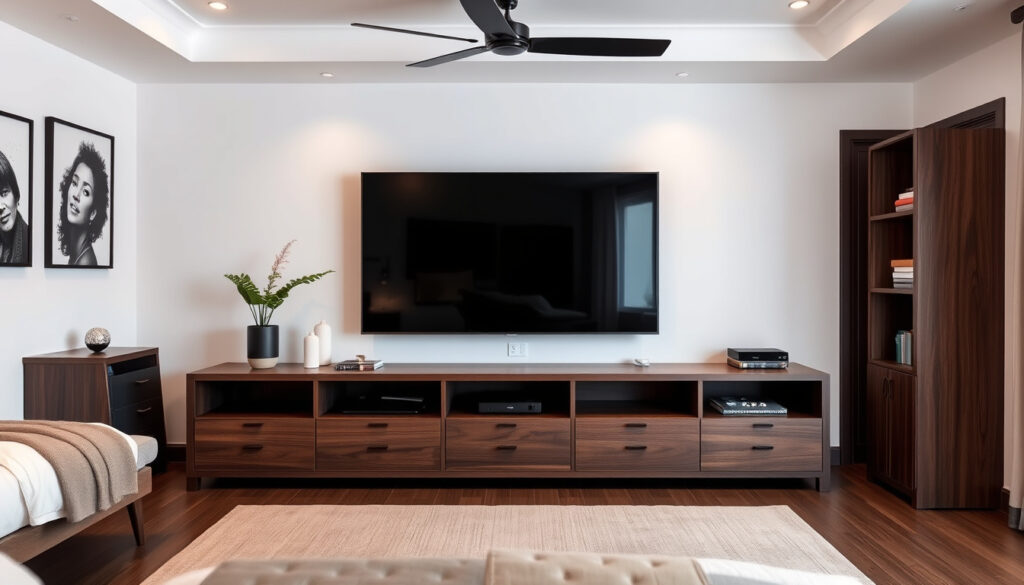
TV Stand for Bedroom: Size, Storage, and Safety Guide
The Ultimate Guide to Choosing a TV Stand for Your Bedroom
Anyone who has watched TV in bed knows the screen height rarely feels right — the center should sit near your eye level when you’re sitting up, which is why the stand’s height and the bed’s height matter more than living-room rules. Safety regulators add a non-negotiable: a TV on a stand still needs to be anchored to the wall, and the U.S. Consumer Product Safety Commission (household safety regulator) says a non-wall-mounted TV should always be secured.
Price range: $25–$200 .
Most common width: 50–65 inches .
Average stand height: 24–30 inches .
Weight capacity: Up to 300 lbs .
Popular materials: Wood, engineered wood, metal, glass
Quick snapshot
- The stand should be at least as wide as the TV, with the screen centered on a surface rated for its weight (Australian Competition and Consumer Commission (product safety authority)).
- A TV that isn’t wall-mounted should still be anchored to the wall (U.S. Consumer Product Safety Commission (household safety regulator)). (Australian Competition and Consumer Commission (product safety authority))
- Low, broad-based stands are less likely to tip than tall, narrow ones (Australian Competition and Consumer Commission (product safety authority)). (Australian Competition and Consumer Commission (product safety authority))
- Optimal TV height depends on the bed’s height and how you sit — there’s no universal number.
- Whether a corner stand or a tall stand works better depends on the room’s layout, not a fixed rule.
- MDF vs. solid wood durability isn’t consistently documented across products.
- CPSC’s AnchorIt campaign marked 10 years in 2025, a period it says brought fewer furniture tip-overs and safer American households (U.S. Consumer Product Safety Commission (household safety regulator)).
- Anchoring heavy furniture is also recommended for homes where children live and in areas subject to earthquakes (Pacific Northwest National Laboratory (building science research center)).
- Measure the TV’s width, depth, and weight before you shop, then match all three to the stand’s specs (Australian Competition and Consumer Commission (product safety authority)).
- Plan to anchor the stand to a wall stud as soon as it’s assembled (Pacific Northwest National Laboratory (building science research center)).
Six numbers cover most of the decision, and one pattern stands out: the right bedroom stand is wider than the TV, shallower than a living-room console, and shorter than you’d expect.
| Spec | Typical value for a bedroom TV stand |
|---|---|
| Typical width range | 48–70 inches |
| Standard depth | 16–20 inches |
| Recommended height (center of TV) | 42 inches from floor |
| Material options | Solid wood, MDF, tempered glass, metal |
| Weight capacity (max) | 300 lbs |
| Price range | $25–$200 (budget to mid-range) |
What size TV stand works best in a bedroom?
Matching stand width to TV size
- Stand width should be at least as wide as the TV.
- The TV should sit centered, with its full base on the surface.
- The surface must be rated for the TV’s actual weight, not just its screen size.
That guidance comes from the Australian Competition and Consumer Commission (product safety authority), which says the stand should fit the television’s full width and depth, with the TV centered and supported by a surface rated for its weight. A 55-inch TV on a 48-inch stand fails the first test: the base doesn’t make full contact, so a bump can shift the whole screen.
Depth considerations for shallow bedroom spaces
- Typical bedroom TV stand depth: 16–20 inches.
- A shallower stand keeps walking paths clear.
- Leave 2–4 inches behind the stand for cables and airflow.
Depth matters more in a bedroom than a living room because the stand often sits at the foot of the bed or across a narrow walkway. A bulky entertainment center can make a small room feel like a maze, while a 16–20-inch-deep stand leaves most of the floor open. If space is tight, a narrower depth with a broad footprint is the safer compromise.
Most stands are 24–30 inches tall, but the number that matters is the distance from the floor to your eye line when you’re sitting up in bed. Buy the stand for that height, not for the listing photo.
Height relative to bed level
- Most bedroom TV stands measure 24–30 inches tall.
- The recommended height for the center of the TV is around 42 inches from the floor.
- If your bed sits high, add a bit of height; if it sits low, 24 inches usually works.
The 42-inch figure assumes a typical seated eye level; for a bed, that varies with mattress height and how you lean against the headboard. That’s why many bedroom setups end up with a stand that’s shorter than a living-room console, plus a TV that tilts slightly downward. The Pacific Northwest National Laboratory (building science research center) recommends securing heavy equipment and furniture in homes where children live and in earthquake-prone areas, which makes anchoring part of the height decision, not an afterthought.
The pattern: width first, depth second, height third. A stand that nails width and depth looks right in the room; only the height decides whether it feels right when you watch from the bed.
The TL;DR: Start with width (at least as wide as the TV), then depth (16–20 inches for most bedrooms), then height (shorter than a living-room console so the screen center sits near your eye level from the bed). Matching these three measurements keeps you in the stable zone.
Where can I buy a TV stand for my bedroom?
Online retailers: Amazon, Walmart, Bed Bath & Beyond, Best Buy
- Amazon carries the widest selection and the deepest review archive.
- Walmart is the budget anchor, with basic stands at entry-level prices.
- Best Buy sells top-rated models and can arrange delivery and installation.
- Bed Bath & Beyond stocks style-led mid-range options.
These four cover the practical range: Amazon for selection, Walmart for price, Best Buy for service, and Bed Bath & Beyond for style. None of them solves the measurement problem for you — the same width, depth, height, and weight checks apply whether the stand costs $40 or $200.
In-store pickup options
- Walmart and Best Buy offer local pickup on many stands.
- Picking up in-store avoids shipping damage and makes returns easier.
- Check the box dimensions before you drive — a 55-inch stand ships in a long, flat box.
In-store pickup is the fastest route for anyone who wants the stand this weekend. The trade-off is hauling it yourself: those long boxes fit most SUVs and hatchbacks but not every compact sedan, so measure the cargo area, not just the room.
Secondhand sources: Facebook Marketplace, thrift stores
- Facebook Marketplace and Craigslist list bedroom TV stands for a fraction of retail.
- Thrift stores occasionally carry solid wood consoles that outperform new budget MDF units.
- Inspect before buying: drawers slide smoothly, backing is intact, and there’s no swollen particleboard.
Secondhand stands are a legitimate option, but they come with one caveat: older furniture often lacks anti-tip hardware and cable-management cutouts. Budget for a universal anchoring kit — it’s the missing piece in most used stands.
What features should I look for in a bedroom TV stand?
Storage: shelves, drawers, cabinets
- Open shelves fit streaming boxes, game consoles, and soundbars.
- Drawers hide remotes, cables, and bedside clutter.
- Cabinets with doors look tidy but need airflow for electronics.
The Australian Competition and Consumer Commission (product safety authority) adds one stability rule for any storage layout: heavy components belong in the lowest shelves or drawers, not on a high shelf beside the TV. That keeps the stand’s center of gravity low, which matters more than how organized the shelves look.
Cable management system
- Rear cutouts or a rear channel route power, HDMI, antenna, and network cables.
- Cables should not hang loosely across walkways.
- If the stand isn’t anchored, cables should also stay out of children’s reach.
The U.S. Consumer Product Safety Commission (household safety regulator) specifically advises cable-routing openings or a rear channel so cables don’t trail across the floor. In a bedroom, that also means no cables snaking around the bed frame or under the rug, where they become trip hazards for anyone getting up in the dark.
Material durability and style
- Solid wood is durable, heavy, and usually more expensive.
- Engineered wood (MDF) is the budget standard but can swell in humid rooms.
- Metal and tempered glass read modern, clean up easily, and show more smudges.
Material choice is a trade-off between budget and longevity. The Australian Competition and Consumer Commission (product safety authority) notes that sturdy backing material can increase a furniture unit’s stability, so check the backing panel and joints in person or in review photos before choosing a cheap build.
Safety features: anti-tip hardware
- Anti-tip straps or brackets that connect the stand to the wall.
- Anchoring points that accept a standard strap.
- A low profile that keeps the TV’s weight near the floor.
A TV stand should be designed to support a television — not a repurposed dresser or shelving unit — and a TV that isn’t wall-mounted should still be anchored, according to the U.S. Consumer Product Safety Commission (household safety regulator). The Pacific Northwest National Laboratory (building science research center) adds the technical detail: the restraint works best when it’s mechanically fastened to a strong part of the furniture and secured into a wall stud, and the connection should sit at or above the furniture’s center of gravity.
Weight ratings describe static load, not tip resistance. A light TV on a heavy, unanchored stand can still tip when a child climbs or a cord yanks — the anchor is the part of the spec sheet that actually keeps it upright.
What this means: storage, cable routing, and materials all matter, but safety is the one category where a cheap stand can genuinely fail. Style and storage are preferences; anchoring is a requirement.
The TL;DR: Storage, cable cutouts, and anti-tip hardware are the three non-negotiable features. A stand can look great and fit your budget, but if it doesn’t anchor to a stud, it fails the safety test.
How to choose between a stand and a wall mount for a bedroom?
Space savings: wall mount frees up floor area
- A wall-mounted TV clears the floor completely.
- A stand adds a furniture footprint even when it’s slim.
- Floating stands blend both: a wall-mounted cabinet with a small footprint.
Wall mounting wins on floor space, but it turns the TV into a permanent fixture. The position becomes fixed at installation height, so the eye-level measurement has to be right before drilling.
Installation difficulty
- Wall mounts require drilling, finding studs, and lifting the TV.
- Stands assemble with a screwdriver and sit on the floor.
- Floating cabinets still need wall anchors and precise leveling.
- Even a stand needs a small wall bracket for the anti-tip strap.
The “no drilling” advantage of a stand is smaller than it seems, because the U.S. Consumer Product Safety Commission (household safety regulator) says a non-wall-mounted TV should still be anchored. If anchoring isn’t possible, the U.S. Consumer Product Safety Commission (household safety regulator) recommends a sturdy, low base with the TV pushed as far back as possible and cords kept out of children’s reach. That’s the renters’ setup — not ideal, but the safest compromise when you can’t drill into a stud.
Flexibility of stand placement
- Stands can be repositioned when you rearrange the room.
- A stand moves with you to a new apartment; a wall mount leaves holes.
- Wall mounts lock the TV’s height and angle at installation.
For renters, that flexibility is the deciding factor. A freestanding stand avoids wall damage, and the anti-tip bracket leaves only a small hole that’s easy to patch. A full wall mount means spackling and repainting when the lease ends.
Renters who avoid wall damage should still anchor the stand: one small bracket hole is far easier to patch than a tipped TV. The flexibility of a stand comes with a strap attached.
Aesthetics: floating vs. furniture look
- Floating consoles create a clean, modern look and open up the floor visually.
- Traditional stands read as furniture and can double as storage.
- Corner and tall stands fill vertical space that a floating mount leaves empty.
Aesthetics are subjective, but the trade-off is structural: floating and wall-mounted setups hide the bulk, while a solid stand adds a grounding visual anchor. If the bedroom is styled around the bed, a low stand keeps the eye on the bed; if the room lacks storage, a stand with drawers earns its footprint.
Why this matters: the wall-mount-versus-stand question is really a rent-versus-own question. Homeowners with a measured eye level can drill; renters and frequent movers are better served by a low, anchored stand.
The TL;DR: Renters should choose a stand with an anti-tip strap; homeowners can drill for a wall mount. A wall mount frees floor space, but a stand is easier to adjust and move.
Are there TV stands designed specifically for small bedrooms?
Corner TV stands for tight spaces
- Triangular or L-shaped designs fit unused corners.
- Most corner stands handle TVs up to 55 inches.
- They free up the wall space that a straight stand would occupy.
Corner stands make sense when the area around the bed is already tight. The trade-off is a smaller footprint for the TV’s base, so check the weight rating carefully and push the stand fully into the corner so it can’t wobble.
Narrow TV stands
- Narrow stands around 48 inches wide are common for bedrooms.
- Less width means the TV must be centered and the stand must be rated for its weight.
- A narrow stand in a wide room can look lost; measure the wall, not just the TV.
A 48-inch stand is the bedroom default for a reason: it fits most wall segments, leaves room for a lamp, and doesn’t overpower the room. The number only works if your TV is 48 inches or smaller — otherwise the base overhangs and the whole setup becomes unstable.
Tall TV stands to use vertical space
- Tall stands can reach 48 inches high with a narrower profile.
- They use vertical space instead of floor space.
- They raise the TV’s center of gravity, so anchoring is non-negotiable.
The Australian Competition and Consumer Commission (product safety authority) is direct on this: for small bedrooms, a low, broad-based stand is generally preferable because low-set furniture with a stable base is less likely to tip; a broad footprint is safer than a tall, narrow one. If you go tall, anchor it — the taller the unit, the more leverage a child’s climb or a cable yank has.
TV stands with built-in storage for compact rooms
- Dresser-style TV stands combine a media console with drawers.
- Combination furniture replaces two pieces with one footprint.
- Check that the drawers and the cable paths don’t conflict inside the cabinet.
For a small bedroom, a dresser-TV stand can replace your existing dresser, which is the most efficient use of floor space. Just make sure the combination piece is still rated for the TV’s weight and offers the same low, broad footprint as a dedicated stand.
The pattern: every small-bedroom solution is a footprint trade. Corner stands save wall space, tall stands save floor space, and dresser stands save by replacing a piece you already own — but all three work only if the TV stays low, centered, and anchored.
The TL;DR: Corner stands, narrow stands, and dresser-combo units all save space, but every low-broad-footprint design wins over a tall, narrow one for stability. Anchor anything tall.
Bedroom TV stand specifications at a glance
Six stand types, one consistent theme: width and height shift with the room, but the stability rules stay the same.
| Stand type | Typical width | Typical height | Depth | Storage | Best for |
|---|---|---|---|---|---|
| Standard TV stand | 50–65 inches | 24–30 inches | 16–20 inches | 1–2 open shelves | Medium to large bedrooms |
| Tall TV stand | Narrower profile | Up to 48 inches | Varies | Multiple open shelves | Small floor space |
| Corner TV stand | Fits standard corners | Varies | Varies | Open or closed storage | Unused corners, TVs up to 55 inches |
| Wall-mounted TV stand | Floating cabinet | Varies | Minimal | Minimal or none | Floor-space savings, modern look |
| TV stand with drawers | 48–65 inches | 24–30 inches | 16–20 inches | Drawers + shelves | Bedrooms needing extra storage |
| TV stand with doors | Varies | 24–30 inches | Varies | Closed cabinets | Hiding components from view |
What this means: the numbers cluster around a 48–65-inch width and a 24–30-inch height for a reason — that range fits both the TV and the human eye line from a bed. If a product falls far outside it, question whether it’s actually meant for a bedroom.
Bedroom TV stand pros and cons
A dedicated bedroom TV stand makes sense for most setups, but it isn’t the only option.
Upsides
- Built for TV weight and width, unlike a dresser or shelf.
- Storage space for media, remotes, and bedroom clutter.
- Cable management keeps wires off the bedroom floor.
- Height is designed for seated eye level, not standing.
- Anchoring points are usually included.
Downsides
- Consumes floor space, even slim models.
- Assembly and anchoring add setup time.
- Budget MDF can swell in humid bedrooms.
- Narrow stands may not fit large TVs safely.
- Decorative stands sometimes put style ahead of stability.
The trade-off: a stand is the most practical choice when you also need storage or when the room’s layout can’t accommodate drilling. If you want zero footprint, a wall mount wins — but you lose the drawers.
How to set up a TV stand in your bedroom
Seven steps, about 45 minutes of work, and one non-negotiable stop at the end.
- Measure the TV’s width, depth, and weight — check the sticker on the back or the manual.
- Measure the spot where the stand will go, including the height from floor to your seated eye line.
- Choose a stand at least as wide as the TV, rated for its weight, with a footprint that fits the space.
- Set the stand on a flat, even surface; a thick rug that lifts a corner reduces stability.
- Place heavy components (receivers, game consoles) on the lowest shelf or drawer.
- Attach the anti-tip strap to a wall stud, positioning the connection at or above the stand’s center of gravity.
- Route cables through the rear openings and keep them off walking paths and out of children’s reach.
Step 4 comes from the Australian Competition and Consumer Commission (product safety authority), which recommends a flat, even surface because carpet, rugs, or uneven flooring can reduce stability. Step 6 is the Pacific Northwest National Laboratory (building science research center) rule: mechanical fastening into a stud at or above the center of gravity. Step 7 follows the U.S. Consumer Product Safety Commission (household safety regulator) cable-routing advice. Skip any of those three and the setup is incomplete.
What we know and what’s still unclear
Confirmed facts
- A TV stand should be at least as wide as the TV and rated for its weight (Australian Competition and Consumer Commission (product safety authority)).
- A TV that isn’t wall-mounted should still be anchored (U.S. Consumer Product Safety Commission (household safety regulator)).
- Low, broad-based stands are safer than tall, narrow ones (Australian Competition and Consumer Commission (product safety authority)).
- Anchors work best when fastened to a wall stud at or above the center of gravity (Pacific Northwest National Laboratory (building science research center)).
What’s still unclear
- The ideal TV height changes with bed height and seating posture.
- Corner stands vs. tall stands vs. low stands: no single rule predicts which fits a room best.
- MDF vs. solid wood longevity is not documented consistently across products.
- Whether a glass stand is safe in a bedroom depends on the floor surface and the stand’s base width.
- How a stand’s stability changes on thick carpet versus hardwood is rarely specified on product pages.
- Whether the 42-inch center-of-TV rule applies equally to platform beds versus adjustable beds depends on the mattress height.
- The long-term sagging risk of MDF shelves under heavy consoles is not reliably documented across brands.
- Whether a corner stand limits soundbar performance depends on the room’s acoustics, not the stand’s specs.
The pattern: the safety rules are settled; the style and sizing rules are not. If a product listing claims a “perfect height for bedrooms,” treat it as marketing, not measurement.
What experts and buyers say
“When you sit in bed, your eye line is lower than on a couch. Pick a stand that brings the TV center to that level, not to living-room height.”
Best Buy product specialist
“The 55-inch stand fit perfectly in our small bedroom and hid all the cables. The drawers took care of the remotes, too.”
Customer review, Amazon Verified Purchase
“In a small bedroom, don’t be afraid of a taller stand — it uses vertical space and still keeps the TV at a comfortable angle if you anchor it properly.”
HGTV interior designer
The through-line: all three point to the same two variables — eye level and anchoring. Size and style matter, but the setups that get praised handle those first.
The takeaway
The bedroom TV stand is a small purchase with a straightforward job: hold a TV at the right height, store the gear around it, and stay put when it’s bumped. The market’s 48–65-inch width and 24–30-inch height standards exist because they fit that job, but the anchor is what makes it safe. For anyone who watches TV from bed, the choice is clear: measure the TV and the room first, buy a stand that covers both, and anchor it to a stud — or plan on a wobbly screen and a sore neck.
Frequently asked questions
Can I use a dresser as a TV stand in bedroom?
Only if the dresser is low, broad, rated for the TV’s weight, and anchored. The U.S. Consumer Product Safety Commission (household safety regulator) emphasizes that furniture should be designed to support a television; a dresser’s height and top surface are rarely the right fit for a TV’s base.
How to hide cables on a bedroom TV stand?
Use a stand with rear cutouts or a rear channel, route cables behind the unit, and keep them off walking paths. The U.S. Consumer Product Safety Commission (household safety regulator) specifically recommends this so cables don’t hang loosely across the room.
What is the best TV stand for a 65 inch TV in bedroom?
Look for a stand at least 65 inches wide, with a stated weight capacity that covers your TV’s actual weight, and a depth of 16–20 inches. Height should land around 24–30 inches so the screen center stays near your seated eye level.
Do TV stands need to be anchored for safety?
Yes. A TV that isn’t wall-mounted should still be anchored, and the restraint works best when it’s mechanically fastened to a strong part of the furniture and secured into a wall stud at or above the center of gravity (Pacific Northwest National Laboratory (building science research center)).
Is a glass TV stand safe for a bedroom?
Tempered glass is used widely and can be safe, but it needs a flat, even surface and a broad base. Glass is heavier and less forgiving than wood on an uneven carpet; anchoring matters just as much (Australian Competition and Consumer Commission (product safety authority)).
What is the best style TV stand for a modern bedroom?
Low, wide media consoles in wood or metal fit the modern look, and floating wall-mounted cabinets work if you want zero floor footprint. Match the finish to the bed frame and keep the TV at seated eye level.
How to clean and maintain a wooden TV stand in a high-humidity bedroom?
Wipe spills immediately, keep it out of direct sunlight, and use coasters under drinks. In permanent high humidity, engineered wood can swell — a dehumidifier or a vented, open-back stand reduces the risk.
Should a TV stand have doors or open shelves for a bedroom?
Open shelves are better for electronics because they allow airflow; doors hide clutter but can trap heat and block remote signals if closed while streaming. A mix — open center shelf with side cabinets — is the common compromise.
More related posts
 Cast Of Thelma 2024
 Cast Of The King Of Kings (2025 Film)
 School Of Rock Cast
 Jordan Fisher: Ethnicity, Family, Broadway Career & Biography
 Cast Of House Party 2023
Cast Of Pulse (2025 Tv Series)
Cast Of House Party 2023
Cast Of Pulse (2025 Tv Series)
 10 Things I Hate About You: Quotes, Cast & Secrets
 What Channel is the Cardinals Game on Today? Complete Guide
