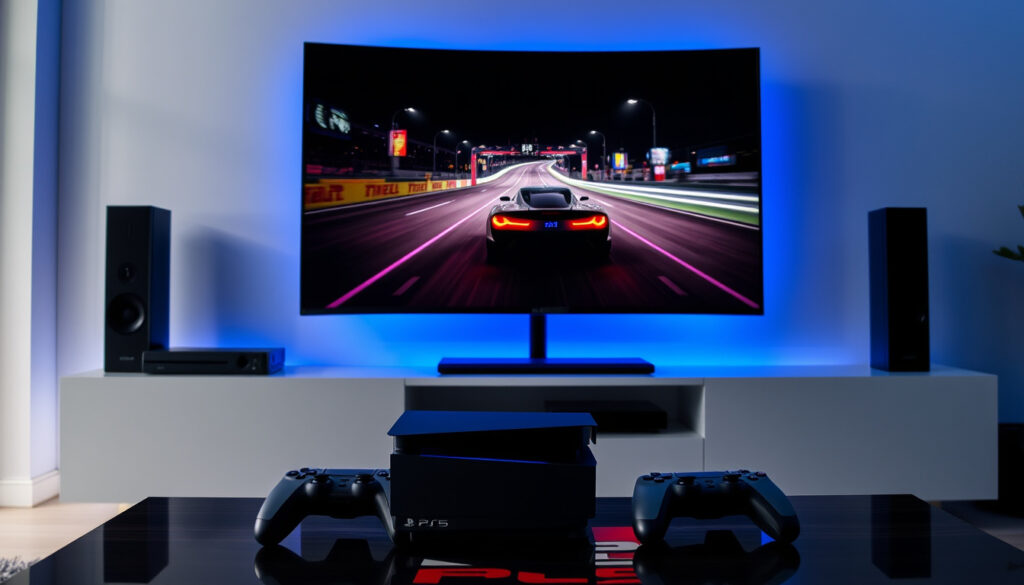
Best TV for PS5 in 2025: Expert Picks for Every Budget
Anyone who has paired a PS5 with an older TV already knows the feeling: the console is fast, but the screen is holding it back. Most of that bottleneck traces back to one spec — HDMI 2.1 — which unlocks the PS5’s 4K 120Hz output, a capability confirmed by PlayStation Support (Sony’s official console help hub). OLED, QLED, and budget LCD panels all approach that spec differently, and knowing the difference separates a great purchase from a regret. You’ll leave with a short checklist of features that actually matter for PS5 gaming in 2025.
PS5 maximum output: 4K at 120Hz ·
Required interface: HDMI 2.1 for 4K 120Hz ·
VRR support: Yes, reduces screen tearing ·
ALLM support: Yes, auto low latency mode
Quick snapshot
- PS5 outputs 4K at 120Hz over HDMI 2.1 (PlayStation Support (Sony’s official console help hub))
- HDMI 2.1 carries the PS5’s VRR and ALLM signals (Currys (UK electronics retailer))
- OLED remains the panel type to beat for PS5 picture quality (TechRadar (consumer tech review outlet))
- The best TV under $500 shifts with sales and regional stock
- OLED burn-in risk depends on individual usage patterns
- Long-term reliability of 2025 models is still unproven
- LG’s 2025 OLED lineup adds 4K 144Hz panels (What Hi-Fi? (audio-visual review publication))
- TechRadar reports the LG C6 has replaced the LG C5 as the best gaming TV (TechRadar (consumer tech review outlet))
- Verify HDMI 2.1 on the spec sheet, not the marketing copy (Sony UK Support)
- Budget shoppers should watch for 2024 OLED price drops as 2025 sets land
Six facts, one takeaway: the PS5’s requirements are fixed, so the TV has to match them — not the other way around.
| Fact | Value |
|---|---|
| PS5 max resolution | 4K (3840×2160) at 120Hz |
| HDMI standard required for 4K 120Hz | HDMI 2.1 |
| Variable Refresh Rate (VRR) | Supported via HDMI 2.1 |
| Auto Low Latency Mode (ALLM) | Supported |
| Best panel type for contrast | OLED |
| Recommended size for immersion | 55–65 inches |
What is the best TV for PS5 gaming?
The best TV for a PS5 handles the console’s headline features without compromise: 4K at 120Hz, VRR, and ALLM. All three live behind the HDMI 2.1 spec, and together they separate a real PS5 upgrade from a screen that just looks big.
Best overall PS5 TV features
- Native 4K at 120Hz output. Sony UK Support (the manufacturer’s regional help desk) says buyers must verify a TV supports HDMI 2.1 rather than HDMI 2.0 for 4K 120 FPS gaming.
- ALLM support, so the TV drops into its lowest-latency mode automatically when a game starts. Samsung (display manufacturer) lists it as a core gaming-TV feature.
- VRR support, so frame-rate dips stay smooth instead of tearing the picture.
Start with these three boxes ticked, and the rest of the decision — panel type, size, budget — falls into place.
Budget-friendly options under $500
- 50–55 inch models in the $400–$500 band, such as the TCL S546 and Hisense U6K
- Expect 60Hz panels here; true 4K 120Hz remains rare below $500
- HDR brightness and contrast matter more than a sticker that says “gaming mode”
A budget 4K set is a legitimate stopgap for PS5, because the console’s sharpness still comes through at 60Hz. The trade-off: you lose the 120fps performance modes that make the console feel genuinely next-gen.
Top-rated TVs for PS5
- PC Guide (gaming hardware publication) names the LG C3 55-inch OLED as its best TV for PS5
- The expert pattern is hard to miss: LG’s C-series OLEDs keep taking the top gaming-TV spots
- Waiting a few months often lands a previous C-series model at a meaningful discount
The consensus points one way: for PS5, the panel that flatters 4K 120Hz most is a mid-to-high-end OLED. Budget buyers are the exception, and the list above is their lane.
Do I really need a 120Hz TV for PS5?
Not for every game, but yes if you want the PS5 running at its full potential. The console can output 120Hz, and Currys (UK electronics retailer) is blunt about the payoff: 120Hz is better than 60Hz when the game and the display both support it.
PS5 games that support 120Hz
- Shooters, racers, and fighting games are where 120fps modes show up most
- PC Guide (gaming hardware publication) notes that not all games run at 120Hz, so a 144Hz TV is not required for PS5
- Many titles let you choose between a 4K quality mode and a 120fps performance mode
Difference between 60Hz and 120Hz gaming
- 120Hz doubles the frames on screen each second, so motion looks cleaner and camera pans stay readable
- VRR removes screen tearing when frame rates fluctuate, and it works over HDMI 2.1
- ALLM cuts input lag by auto-switching the TV to its fastest picture preset
A “120Hz” label on a box does not guarantee 4K at 120Hz. Sony warns that TV manufacturers are still improving 4K 120Hz support, and firmware updates are often the fix when a set misbehaves.
The practical test: if your favorite games offer a 120fps mode, a 120Hz TV changes how they feel. If you mostly play story-driven titles at 30–60fps, spend the difference on size or contrast instead.
Is it worth getting a 4K TV for PS5?
Yes — 4K sharpens nearly everything the PS5 puts on screen, while 120Hz only changes the games that support it. That makes 4K the first box to tick and the panel behind it the second.
Benefits of 4K resolution
- Four times the pixels of 1080p, so edges, text, and HUDs look cleaner
- 4K holds up on large screens — the jump is obvious at 55 inches and above
- Streaming services upgrade too, so the TV improves more than just games
PS5 game support for 4K
- The PS5 was built around 4K, and its biggest games target that resolution
- Titles that render below 4K are upscaled to fill the panel cleanly
- A 4K 60fps mode is the standard middle ground across the PS5 library
1080p vs 4K visual difference
- On a 55-inch screen from sofa distance, the jump is obvious
- On a 43-inch bedroom set, the difference narrows sharply
- Rule of thumb: the bigger the screen, the bigger the 4K payoff
What this means: 4K is the non-negotiable layer of the PS5 picture. Resolution sets the floor, panel quality sets the ceiling, and size decides how much of both you can see.
Is 4K or OLED better for gaming?
The question mixes two different things: 4K is a resolution, and OLED is a panel type. A 4K TV can be OLED, QLED, or budget LED. For PS5, the real comparison is OLED versus QLED/LED.
OLED advantages: contrast, response time
- Perfect blacks and infinite contrast, because each pixel lights itself
- Fastest response times among mainstream TVs, so fast motion stays crisp
- Wide viewing angles that hold color when you sit off-center
TechRadar (consumer tech review outlet) notes that OLED TVs usually carry a fast 120Hz or 144Hz refresh rate, which is good for gaming.
OLED drawbacks: burn-in, cost
- Static HUDs left on screen for hundreds of hours carry a burn-in risk
- OLED still costs more per inch than LED, though premiums are shrinking
- Peak brightness trails the brightest QLEDs, which matters in sunny rooms
QLED/LED advantages: brightness, longevity
- Higher peak brightness for HDR highlights and daylight viewing
- No burn-in risk, so a racing game’s permanent speedometer is safe
- Better value at large sizes — 65-inch QLEDs often undercut 55-inch OLEDs
LG’s 2025 OLED lineup, detailed by What Hi-Fi? (audio-visual review publication), includes 4K 120Hz and 4K 144Hz modes plus VRR and ALLM — proof that OLED competes on gaming specs, not just picture quality.
Pick OLED when image quality is the whole point and your playtime spreads across different games. Pick QLED/LED when bright rooms, long sessions, or budget lead the decision.
The trade-off in one line: OLED buys the best picture a PS5 can produce, and QLED buys confidence — in brightness, longevity, and value.
What size TV is best for PS5 gaming?
Size matters less than features, but it decides whether those features are visible. On a 43-inch screen, 4K and 120Hz are hard to appreciate; on a 55- or 65-inch screen, they are the whole show. That is why this guide’s recommended range for immersion is 55–65 inches.
Optimal viewing distance
- Sit about 1 to 1.5 times the screen diagonal away for 4K to resolve properly
- A 55-inch TV rewards seating roughly 5.5 to 8 feet away
- Move farther back and the 1080p-to-4K difference fades
Size recommendations by room
- Bedroom or desk setup: 43–50 inches
- Average living room with a sofa 8–10 feet away: 55–65 inches
- Dedicated media room: 75 inches, if the seating distance cooperates
65 inch vs 55 inch for PS5
- 65 inches adds immersion without changing the sharpness of a 4K signal
- 55 inches often unlocks a better panel — an OLED instead of a mid-range QLED — for the same budget
- Measure the space first: 65-inch frames vary by brand, and the stand can be wider than expected
What this means: distance first, size second, panel third. If your sofa sits close, 55 inches of OLED beats 65 inches of budget LED. If the room is large, size wins — 4K needs room to show off.
PS5 TV comparison: OLED vs QLED vs budget
Three panel approaches, one pattern: the more contrast and response a display offers, the more it costs.
| Feature | OLED | QLED/LED | Budget LED |
|---|---|---|---|
| Contrast | Perfect blacks, infinite | Strong, with local dimming | Moderate |
| Peak brightness | High | Very high | Moderate |
| Response time | Fastest | Fast | Good for 60Hz |
| Burn-in risk | Possible with static HUDs | None | None |
| HDMI 2.1 for 4K 120Hz | Common on 2024–2025 models | Common on mid-range and above | Rare under $500 |
| Price, 55-inch class | Premium | Mid-range | Lowest |
| Best for | Picture quality first | Bright rooms, long sessions | Casual PS5 play |
The pattern is simple: each step down in budget trades contrast or brightness for a lower price. The PS5 runs well on all three; it only sings on the first two.
PS5 TV requirements: spec checklist
One checklist, one purpose: the specs Sony expects from a TV that shows the PS5 at its best.
| Requirement | What to look for |
|---|---|
| Resolution | 4K (3840×2160) |
| Refresh rate | 120Hz for the PS5’s full output |
| HDMI | HDMI 2.1 with an Ultra High-Speed cable — the PS5-included cable works (Sony UK Support) |
| VRR | Supported on HDMI 2.1 sets |
| ALLM | Supported; Samsung (display manufacturer) lists it as a core gaming-TV feature |
| Panel type for best contrast | OLED |
| Recommended size for immersion | 55–65 inches |
Read the port list before you buy: a TV can advertise HDMI 2.1 and still route it through only one input. The PS5 needs that specific port.
PS5-ready TVs: upsides and downsides
Every feature that makes a TV great for PS5 has a cost attached somewhere. Here is the honest scorecard.
Upsides
- HDMI 2.1 unlocks 4K 120Hz, VRR, and ALLM in one port
- 120Hz makes supported games visibly smoother
- OLED delivers the best contrast and response for gaming
- 4K improves every game, not just the ones with a 120fps mode
Downsides
- Full HDMI 2.1 sets cost more, especially at 55 inches and above
- Budget models under $500 rarely deliver true 4K 120Hz
- OLED burn-in demands varied content and some HUD caution
- 4K 120Hz is still maturing — some sets need firmware updates to behave
Confirmed facts vs what’s still unclear
Confirmed facts
- PS5 supports 4K at 120Hz over HDMI 2.1 (PlayStation Support (Sony’s official console help hub))
- PS5 supports VRR and ALLM through HDMI 2.1 (Currys (UK electronics retailer))
- LG’s 2025 OLED lineup ships with 4K 120Hz, 4K 144Hz, VRR, and ALLM (What Hi-Fi? (audio-visual review publication))
What’s unclear
- Which TV is “best” under $500 shifts with sales and regional stock
- OLED burn-in risk depends on individual usage patterns
- Long-term reliability of 2025 TV models is still unproven
- Whether a specific HDMI 2.1 port actually delivers full 4K 120Hz bandwidth varies by model
What the sources say
“Not all games run at 120Hz, so a 144Hz TV is not required for PS5 gaming.”
— PC Guide, gaming hardware publication’s PS5 TV guide
“OLED TVs usually have a fast 120Hz or 144Hz refresh rate, which is good for gaming.”
— TechRadar, consumer tech review outlet’s OLED TV guide
Final take
The PS5 is only as fast as the screen in front of it. HDMI 2.1, VRR, ALLM, and 4K 120Hz are not optional extras — they are the console’s core feature set, and every TV purchase is really a decision about which of those you can afford. For the gamer on a budget in the US, the choice is clear: buy the best 4K 60Hz LED you can find now, or save for a 55-inch OLED with full HDMI 2.1 — the middle ground only delays the upgrade that actually matters.
Frequently asked questions
Can I use a 4K 60Hz TV with PS5?
Yes. A 4K 60Hz TV shows everything the PS5 does and simply caps the frame rate at 60fps. You miss the console’s 120fps performance modes, not the console itself — 4K detail still displays in full. If you mostly play story-driven games, this is a sensible setup.
Does PS5 support 8K resolution?
The PS5’s HDMI 2.1 connection can carry 8K signals, but 8K gaming content is still essentially nonexistent, and Sony’s own support guidance centers on 4K output. Treat 8K as future-proofing, not a reason to pay extra today.
What is Variable Refresh Rate (VRR)?
VRR lets the TV match its refresh rate to the game’s frame rate in real time. When a PS5 game dips from 60fps to 50fps, a VRR display keeps the picture smooth instead of tearing. It works over HDMI 2.1.
What is Auto Low Latency Mode (ALLM)?
ALLM is a handshake between the console and the TV: when the PS5 sends a game signal, the TV automatically switches to its lowest-latency picture mode, so button presses feel immediate. Samsung (display manufacturer) lists ALLM alongside 4K 120Hz as a core gaming-TV feature.
Is an OLED TV worth the price for PS5 gaming?
If image quality is the priority, yes. OLED delivers perfect blacks and the fastest response times, and most OLEDs ship with a 120Hz or 144Hz panel that fits PS5 gaming. The real costs are the premium and the burn-in risk with static HUDs. Play a varied library and OLED is the best picture a PS5 can show.
Do I need a soundbar with my PS5 TV?
No. A TV’s built-in speakers handle casual play fine. A soundbar improves dialogue clarity and bass in shooters and RPGs, but it is a separate budget decision, not a PS5 compatibility requirement.
What is the best TV brand for PS5?
Feature support beats brand loyalty. LG and Samsung keep appearing in expert picks because their 2024–2025 TVs implement the HDMI 2.1 features the PS5 needs. Sony’s own TVs work well too, but check each model’s HDMI 2.1 support on the spec sheet rather than trusting the badge.
More related posts