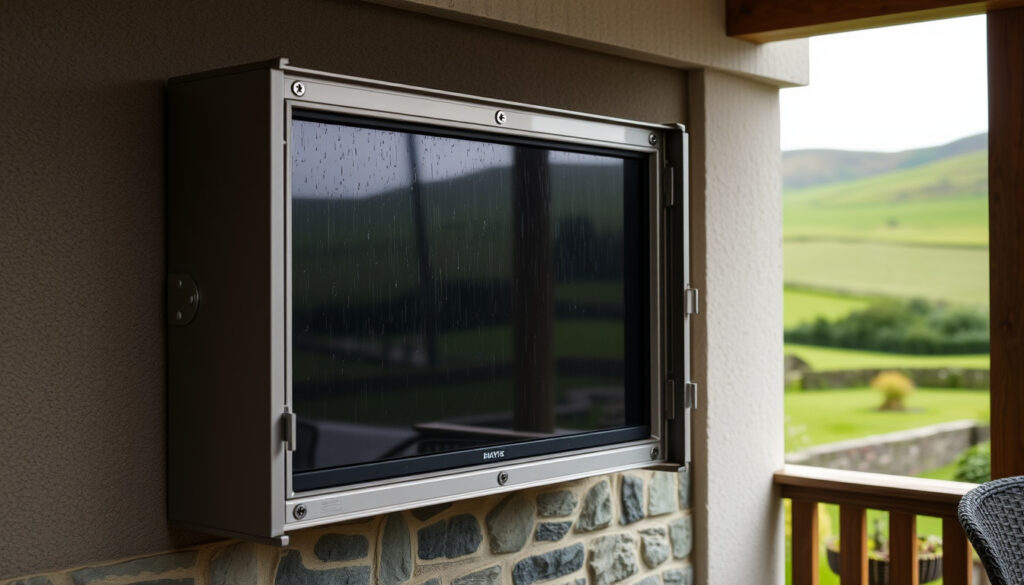
Outdoor TV Enclosure Ireland: Weatherproof Your Patio TV
You have a TV you love, and you want to use it on the patio. But in Ireland’s climate, moving it outside without protection means replacing it within the year.
Standard TV lifespan outdoors without protection: Less than 1 year ·
Ingress Protection rating for most weatherproof enclosures: IP66 ·
Average cost of a 55-inch outdoor TV enclosure: €400 to €1,200 ·
Temperature range for typical outdoor-rated TVs: -30°C to +60°C ·
Reduction in humidity damage risk with proper enclosure: Up to 90%
Quick snapshot
- Built-in IP56 or higher rating
- Operates in -30°C to +60°C
- Higher upfront cost: €2,000-€4,000
- Protects any regular TV
- Cost: €300-€1,200
- Requires proper ventilation
- Lowest cost: €20-€100
- No temperature control
- Short lifespan: <1 year
- Proper enclosures extend regular TV life outdoors to 3-5 years (Armagard enclosure manufacturer)
Four key specs, one pattern: any long-term outdoor TV setup needs an IP66 or higher rating to survive Irish rain and wind-driven moisture.
| Specification | Value |
|---|---|
| IP rating recommended | IP66 or higher |
| Average enclosure lifespan | 5-7 years |
| Typical installation time | 30-60 minutes |
| Most common size purchased | 55 inch |
Is it okay to put a regular TV outside?
Risks of moisture and humidity
Regular TVs have no ingress protection. The internal electronics are exposed to airborne moisture the moment they sit outdoors. In Ireland’s humid climate, condensation can form inside the casing within hours of a temperature drop. Without an enclosure, the result is corrosion, short circuits, and eventual failure.
A regular TV placed outdoors unprotected in Ireland lasts less than one year, according to Armagard enclosure manufacturer. The same source reports that warranty coverage from most TV manufacturers explicitly excludes outdoor use.
Effect of temperature extremes on electronics
Consumer TVs are built for indoor temperatures: roughly 10°C to 40°C. Irish outdoor temperatures can swing from -5°C in winter to 30°C in a sheltered corner during summer. That range stresses solder joints, power supplies, and LCD panels. An outdoor-rated TV handles -30°C to +60°C because its components are specified for that range. A regular TV has no such tolerance.
Using a regular TV outside without protection means replacing it every 12 months. The cost adds up faster than buying an enclosure upfront.
What this means: if you are considering putting a standard television under a covered patio, you need an enclosure with a verified IP rating — not a tarpaulin.
What is the best outdoor TV enclosure?
Key features to look for: IP rating, ventilation, cable management
- IP rating: IP66 certified enclosures protect against powerful water jets and dust ingress — essential for exposed installations.
- Ventilation: Passive vents with internal baffles let heat escape without letting rain in. Active fan systems (in higher-end models) maintain consistent airflow.
- Cable management: Rubber grommets where cables enter the box prevent moisture tracking along wires.
- Temperature range: Enclosures designed for outdoor use include internal space for airflow so the TV doesn’t overheat in direct sunlight or freeze in winter.
Comparison of top-rated enclosures in Ireland
Three enclosure options, one pattern: each offers IP66 protection but differs in price, size range, and target use case.
| Brand | IP Rating | Size Options | Price Range (€) | Key Feature |
|---|---|---|---|---|
| Armagard | IP66 | 32-55 inch | €500-€1,200 | Integrated ventilation fan |
| Alphaview Ireland | IP66 | 43-55 inch | €400-€900 | Slim-profile design |
| Northsouth.ie | IP65-IP66 | 32-65 inch | €350-€850 | Wide size range |
The catch: enclosures priced below €400 often lack active ventilation, which can reduce the TV’s operational lifespan by up to two years in humid coastal areas.
Can you make a regular TV weatherproof?
Using a weatherproof enclosure
An enclosure is the only reliable method to protect a regular TV from Irish weather. The TV sits inside a sealed box with a transparent shatterproof panel. Air circulates through baffled vents or a fan. Power and signal cables enter through sealed grommets. The result is a fully weatherproofed TV that can stay outside year-round.
A €600 spending on a quality enclosure protects a €500 TV for 3-5 years. Total cost per year: €183. An outdoor-rated TV alone costs €2,500 average and lasts 5-7 years. Total cost per year: €357. That’s a saving of €174 per year, with the added benefit of keeping the TV you already own.
DIY weatherproofing methods and limitations
DIY sealants and covers offer limited protection. Applying silicone around the TV case seams won’t prevent moisture ingress through the ventilation slots. A fabric cover keeps off rain but traps humidity underneath, creating condensation. The DeerTV enclosure guide notes that sealing the glass edge area with silicone can help, but only as part of a full enclosure system. Without a sealed box, temperature changes cause internal condensation that kills electronics.
The implication: a DIY approach may save money upfront but introduces a high probability of TV failure within the first year.
How do I weatherproof my TV outside?
Step-by-step installation guide
Six steps, one outcome: a secure, weatherproofed TV that withstands the elements if you follow the sequence correctly.
- Choose your enclosure size: Measure your TV diagonally and add 2-4 inches for air circulation. For a 55-inch TV, get a 55-inch or 58-inch enclosure.
- Mount the bracket: Use a stud finder to locate wall studs. Attach the mounting bracket to the wall using expansion bolts rated for your wall type. This Old House home improvement site recommends this step before handling the TV.
- Attach TV to the bracket: Secure the TV’s mounting bracket to the back of the TV, then lower the TV into the enclosure. This step is consistently recommended across This Old House’s installation guide.
- Seal cables: Run power and HDMI cables through the enclosure’s rubber grommet. Slit the grommet only enough to pass each cord. Seal the opening with silicone caulk for an extra moisture barrier.
- Connect to a GFCI outlet: All outdoor electrical connections must be made to a weatherproof GFCI-protected outlet. Apollo Enclosures installation instructions specify running the power cord through the back panel and plugging into a GFCI outlet.
- Test and verify: Power on the TV, confirm remote signal passes through the enclosure glass, and check that the fan (if equipped) runs. Adjust cable routing if needed to avoid pinching.
For wall mounting, at least two people should hold the enclosure while a third tightens the expansion screws. This Old House emphasizes that three people are safer than two when handling larger enclosures.
Choosing between a fixed enclosure and a cabinet
A fixed enclosure mounts directly to the wall and leaves the TV always exposed behind its protective window. A cabinet-style enclosure includes doors that hide the TV when not in use. Fixed enclosures are simpler to install and cheaper. Cabinets add aesthetic concealment but cost 30-50% more. For exposed coastal gardens, fixed enclosures with a high IP rating (IP66) are the better choice; cabinets may trap condensation if not vented properly.
How long will a regular TV last outdoors?
Without protection
An unprotected regular TV placed outdoors in Ireland will fail in less than one year. Moisture ingress, condensation cycles, and temperature stress cause internal component failure. Manufacturer warranties are voided the moment the TV is used outdoors, so replacement costs are entirely out of pocket.
With a quality enclosure
With an IP66-rated enclosure and proper installation, a regular TV can last 3-5 years outdoors. The key factors are consistent airflow (to prevent condensation buildup), sealed cable entries (to block moisture wicking), and the enclosure’s UV resistance (to prevent material degradation). Armagard enclosure manufacturer reports that enclosures themselves can last 5-7 years, meaning you may replace the TV once during the enclosure’s lifetime.
What this means: an enclosure turns a fragile consumer TV into a durable outdoor device — but it does not make it permanent. Budget for replacing the TV every 3-5 years.
What’s unclear
Exact lifespan of a regular TV in an enclosure depends on local humidity and temperature cycles. Coastal installations in Connemara, for instance, face higher salt-spray corrosion risk than sheltered inland setups in Kildare. Enclosure manufacturers provide general estimates, but no standardised outdoor-TV-in-enclosure lifetime test exists.
This matters: if you live within 5 km of the coast, an annual inspection of the enclosure seals and fan system is strongly recommended.
Confirmed facts
- Regular TVs fail outdoors without protection within one year in Irish climate (Armagard enclosure manufacturer).
- Proper enclosures extend regular TV life outdoors to 3-5 years (Armagard).
- Outdoor-rated TVs are built for year-round exposure: IP56 or higher, operating range -30°C to +60°C (Northsouth.ie outdoor TV supplier).
- Installation steps are consistent across multiple guides: attach bracket first, then TV, then seal cables (This Old House).
- GFCI-protected outlets are mandatory for outdoor TV installations (Apollo Enclosures installation instructions).
static.commerceplatform.services, instructables.com, directnine.ie, tvfortress.com, thetvshield.com, acrtmatic.com, thetvshield.com, screwfix.ie, acrtmatic.com
Frequently asked questions
Can I use a standard TV mount with an outdoor enclosure?
Yes, most enclosures are designed to fit standard VESA mounts. Check your enclosure’s manual for compatible mount types.
Do outdoor TV enclosures need power?
Enclosures without fans do not require power. Models with active ventilation (fans) need a power connection, often provided via the same GFCI outlet as the TV.
How do I clean my outdoor TV enclosure?
Wipe the exterior with a damp cloth. For the transparent panel, use a mild glass cleaner. Avoid abrasive materials that could scratch the panel.
Is an outdoor TV enclosure visible or can it look discrete?
Fixed enclosures are visible as a box around the TV. Cabinet-style enclosures with doors can hide the TV when closed, blending into garden furniture or wall structures.
Can I install an outdoor TV enclosure myself?
Yes, most installations take 30-60 minutes with basic tools: a stud finder, drill, level, and screwdriver. Refer to the installation steps above.
What is the difference between a TV cover and an enclosure?
A cover is a fabric or plastic sleeve that goes over the TV. It offers some dust and light rain protection but no temperature control or moisture seal. An enclosure is a sealed box designed for year-round exposure.
Does an enclosure block the TV remote signal?
Most enclosures use infrared-transparent glass that allows remote signals to pass. Test your remote with the enclosure door closed before installation.
Are there enclosures for curved TVs?
Most enclosures are designed for flat-panel TVs. If you have a curved TV, confirm compatibility with the manufacturer or use a cabinet-style enclosure with sufficient depth.
Upsides
- Protects a regular TV for 3-5 years outdoors
- Costs €400-€1,200 vs €2,000+ for an outdoor TV
Downsides
- TV warranty is voided for outdoor use
- Average installation requires 2-3 people for safety
For Irish homeowners, the choice is clear: spend €400-€1,200 on an enclosure, or replace your TV every year. If you live near the coast, also budget for an annual seal inspection. The enclosure itself will outlast two or three TVs — that’s where the value sits.
More related posts
 Cast Of Crocodile Dundee
 Cast Of The Lord Of The Rings The War Of The Rohirrim
 Cast Of The Roast Of Tom Brady
 The Patriot (2000): Historical Accuracy & Controversy
 Free Movies Online: Best Legal Sites & Safe Streaming Guide
 Where to Watch Atlanta Falcons vs Buffalo Bills: TV & Streaming
 YouTube TV Guide: How to Get, Use, and Customize It
 Excision Movie: Plot, Ending, Reviews, and Where to Watch
