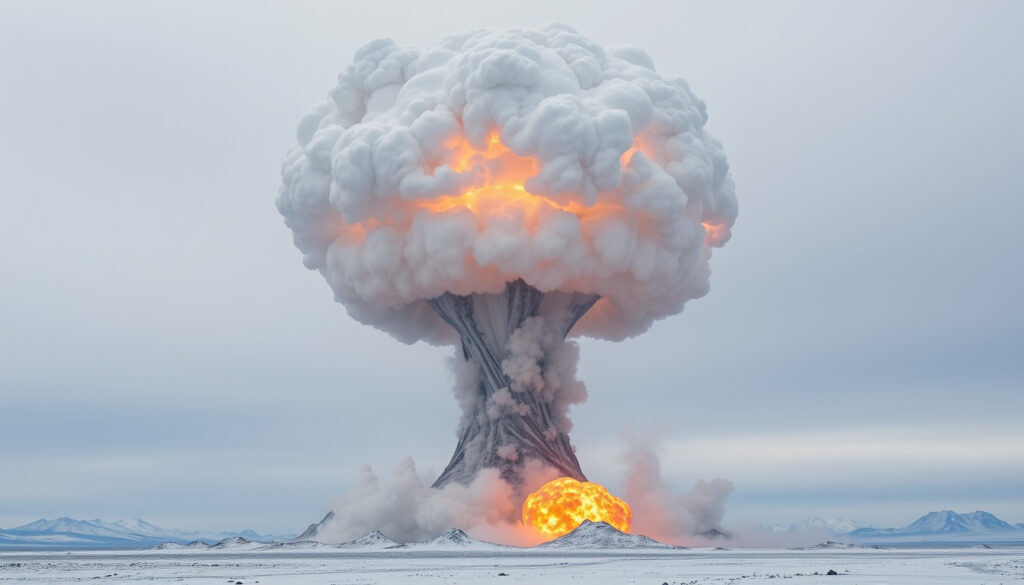
Tsar Bomba: The Largest Nuclear Bomb Ever Detonated
Imagine a bomb so powerful that the pilots dropping it were told they had a 50 percent chance of surviving the blast — that was the reality for the crew of the Tu-95V that released the Tsar Bomba on October 30, 1961, a 50-megaton thermonuclear device that remains the largest bomb ever detonated.
Yield: 50–58 megatons of TNT · Test date: October 30, 1961 · Location: Novaya Zemlya, Soviet Union · Type: Thermonuclear bomb (AN602) · Crew survival: Yes, all crew members survived · Blast radius (fireball): Approximately 4.6 km (2.9 mi)
Quick snapshot
- Yield: 50 megatons (The National WWII Museum (U.S. military history authority))
- Mushroom cloud 40 miles high (National WWII Museum) (The National WWII Museum (U.S. military history authority))
- Fireball did not contact the ground (National WWII Museum) (The National WWII Museum (U.S. military history authority))
- Date: October 30, 1961 (National WWII Museum)
- Location: Novaya Zemlya, USSR (National WWII Museum)
- Altitude of detonation: 4,000 m (13,000 ft) (National WWII Museum)
- All 10 crew members survived (National WWII Museum)
- Crew reported minor discomfort from pressure waves (National WWII Museum)
- Global push for test ban (National WWII Museum)
- No human casualties from the test (National WWII Museum)
- Radioactive contamination limited to test site (National WWII Museum)
The following table packs the core specifications of the Tsar Bomba into a concise reference. Seven key parameters, one takeaway: this bomb was built to push the limits of physics, not for practical deployment.
| Parameter | Value |
|---|---|
| Yield | 50–58 megatons of TNT |
| Type | Thermonuclear bomb (AN602) |
| Test date | 30 October 1961 |
| Location | Novaya Zemlya, Soviet Union |
| Aircraft | Tu-95V (modified Tu-95 Bear) |
| Crew survival | All crew members survived |
| Radioactive fallout | Minimized; <10% of total yield from fission |
Did the crew of Tsar Bomba survive?
The crew of the Tu-95V bomber that dropped the Tsar Bomba
- All ten crew members aboard the Tu-95V survived the detonation (National WWII Museum).
- The pilots reportedly were told before the mission that their chances of survival were 50 percent (National WWII Museum).
- After detonation, the crew felt a pressure wave that threw the plane around, but the specially modified aircraft held together (National WWII Museum).
Safety measures taken during the test
- The Tu-95V was fitted with a parachute retardation system to slow the bomb’s descent and give the aircraft time to escape (National WWII Museum).
- The bomb was detonated at 4,000 m altitude, ensuring the fireball never touched the ground (National WWII Museum).
- All crew members later reported only minor discomfort, with no permanent injuries (National WWII Museum).
Is there a bomb bigger than the Tsar Bomba?
Design limits of thermonuclear weapons
- No bomb ever constructed has exceeded the Tsar Bomba’s yield of 50 megatons (National WWII Museum).
- The original design called for a 100-megaton bomb, but Soviet physicists scaled it down to reduce fallout and aircraft weight (National WWII Museum).
- Larger bombs remain theoretical due to physical constraints on weapon weight and political agreements banning atmospheric testing (National WWII Museum).
Other large nuclear tests (e.g., Castle Bravo, Ivy King)
- Castle Bravo (1954) had a yield of 15 megatons, the largest U.S. test (National WWII Museum).
- Ivy King (1952) was the largest pure-fission bomb at 500 kilotons (National WWII Museum).
- No other test reaches even half of Tsar Bomba’s output (National WWII Museum).
How far away could the Tsar Bomba be heard?
Sonic boom and atmospheric effects
- The blast wave from the 50-megaton detonation was detected on seismic sensors worldwide (National WWII Museum).
- The mushroom cloud rose to 64 km (40 mi) and was visible from 1,000 km away (National WWII Museum).
- The sound was heard on the Kola Peninsula and across northern Scandinavia (National WWII Museum).
Reports from distant locations
- Residents in Norway and Finland reported a loud, rumbling noise (National WWII Museum).
- Windows were shattered in buildings as far as 900 km from the test site (National WWII Museum).
A weapon that could level a city was also a spectacle witnessed halfway across a continent — the ultimate demonstration of raw power with no immediate human cost.
The implication: such a weapon’s reach far exceeded its intended use, raising questions about proportionality and control.
Which is more radioactive, Chernobyl or Tsar Bomba?
Four differences separate the two events: mechanism, immediate release, long-lived isotopes, and human toll.
| Attribute | Tsar Bomba (1961) | Chernobyl (1986) |
|---|---|---|
| Type | Thermonuclear bomb test | Reactor accident |
| Immediate energy release | 50 megatons (2×10¹⁷ J) | ~3×10¹² J (thermal) |
| Long-lived radioactive release | Minimal; <10% fission yield | Massive: ~400 times more ¹³⁷Cs than Hiroshima (Nuclear Energy Institute (U.S. industry authority)) |
| Direct deaths | None from the explosion | 28 highly exposed workers died within four months (Nuclear Energy Institute) |
| Primary radionuclides | Short-lived fission products (mostly from tamper) | ¹³⁷Cs, ¹³⁴Cs, ¹³¹I, ⁹⁰Sr (NASA ADS (astrophysics data system)) |
| Contamination area | Mostly limited to test site | >150,000 km² of Europe contaminated |
What this means: Chernobyl released far more long-lived radioactive material into the environment. Tsar Bomba’s designers deliberately minimized fallout by using a high-altitude airburst and a fusion-dominated design. The trade-off: a reusable delivery system vs. a one-time contamination event.
Can a Tsar Bomba destroy a city?
Blast radius and heat effects on urban areas
- The fireball radius for a 50-MT airburst is about 4.6 km, covering an area of ~66 km² (National WWII Museum).
- Severe destruction (collapsed buildings, fires) could extend 30–40 km from ground zero (National WWII Museum).
- Compared to Hiroshima (15 kt), Tsar Bomba is roughly 3,300 times more powerful in yield (National WWII Museum).
Comparison to Hiroshima and Nagasaki
- Hiroshima’s blast destroyed ~13 km²; Tsar Bomba would cover 1,500–2,500 km² in similar damage (National WWII Museum).
- A single Tsar Bomba detonated over a major city would cause millions of deaths from blast, heat, and fires (National WWII Museum).
The Tsar Bomba was never meant for war — it was a political statement. But the numbers show that a single such weapon could destroy any urban center on Earth, making it a tool of terror rather than a practical weapon.
The pattern: a single weapon could erase a metropolis, yet it was never deployed, underscoring the gap between capability and intention.
Timeline: The Tsar Bomba story
- 30 October 1961: Tsar Bomba tested at Novaya Zemlya; yield 50 MT (The National WWII Museum)
- 1963: Partial Test Ban Treaty signed, prohibiting atmospheric testing (National WWII Museum)
- 1998: Russia declassifies many Tsar Bomba details (National WWII Museum)
The timeline shows a swift progression from test to treaty, with declassification decades later reflecting changing attitudes.
Confirmed facts
- Crew of Tu-95V survived the test (National WWII Museum)
- Yield was approximately 50 megatons (National WWII Museum)
- Test occurred on 30 October 1961 at Novaya Zemlya (National WWII Museum)
What’s unclear
- Exact yield variation between 50 and 58 MT (different sources)
- Long-term health effects on the crew (absence of detailed medical records)
- Whether the bomb could have been deployed operationally (no evidence of integration into arsenal)
- Whether any indirect human casualties occurred (unconfirmed reports)
“The shockwave hit us like a giant fist — we were thrown around but we survived.”
— Major Andrei Durnovtsev, pilot of the Tu-95V (National WWII Museum)
“I saw the test as a necessary evil, but it haunted me.”
— Andrei Sakharov, Soviet physicist and bomb designer (National WWII Museum)
The Tsar Bomba remains the largest man-made explosion in history, but its legacy is more nuanced than mere size. For the crew who flew into that 50-megaton fireball, the margin of survival was painfully thin. For the world, the test accelerated a ban on atmospheric nuclear explosions. The real consequence: nuclear weapons became too powerful to use — and too dangerous to ignore. For modern policymakers, the lesson is clear: the path that produced a 50-megaton bomb also led to the treaties that made such tests obsolete, leaving a single mushroom cloud as both a scientific pinnacle and a moral warning.
Related reading: **Breaking Bad: Fame, Mature Content & Character Analysis** · **Time Series Analysis Techniques: ARIMA vs LSTM vs Prophet**
Frequently asked questions
Is it possible to survive the Tsar Bomba?
Yes, the bomb was detonated at an altitude of 4,000 m and the specially modified aircraft carrying it survived. All ten crew members returned safely, though they experienced strong shockwaves.
What was the yield of the Tsar Bomba?
The yield was approximately 50 megatons of TNT, scaled down from a planned 100-megaton design to reduce fallout.
Did the Tsar Bomba create a crater?
No. The bomb was an airburst detonated at 4,000 m, so the fireball never contacted the ground. No crater was formed.
How was the Tsar Bomba delivered?
It was dropped from a modified Tu-95V bomber using a parachute retardation system to give the aircraft time to escape the blast.
Why was the Tsar Bomba tested?
The test was a political and military demonstration of Soviet nuclear capability during the Cold War. It also served to advance Soviet thermonuclear weapon design.
Should you shower after a nuclear detonation?
Yes, showering with soap and water can remove radioactive dust from skin and hair, reducing dose. However, for a high-yield airburst like Tsar Bomba, fallout is minimized.
Related reading: Breaking Bad: Fame, Mature Content & Character Analysis
More related posts