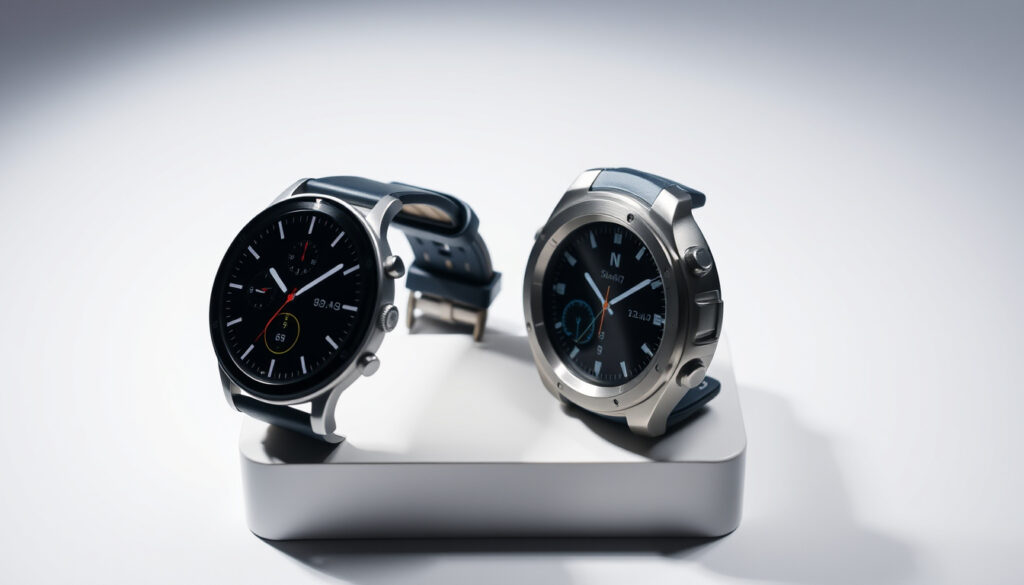
Apple Watch Series 10 vs Ultra 2: Which Should You Buy
Picking between the Apple Watch Series 10 and the Ultra 2 feels like choosing between a sleek daily companion and a rugged adventure partner. The $400 price gap between them tells only part of the story — the real differentiator is how much you push your watch past its coffee-and-notifications routine.
Apple Watch Series 10 starting price: $399 ·
Apple Watch Ultra 2 starting price: $799 ·
Series 10 battery life (typical): 18 hours (claimed) ·
Ultra 2 battery life (typical): 36 hours (claimed) ·
Series 10 case sizes: 42mm and 46mm ·
Ultra 2 case size: 49mm
Quick snapshot
- Starting at $399 (9to5Mac (Apple specialist publisher))
- 42mm or 46mm case (Apple Watch Compare)
- 18-hour battery life (Apple Watch Compare) (9to5Mac (Apple specialist publisher))
- 50m water resistance (DCRainmaker (endurance tech reviewer))
- Thinner and lighter design (PhoneArena (mobile tech authority))
- Starting at $799 (Apple Watch Compare) (Apple Support)
- 49mm titanium case (Apple Watch Compare) (Apple Support)
- 36-hour battery life (Apple Support)
- 100m water resistance + dive computer (DCRainmaker (endurance tech reviewer)) (Apple Support)
- MIL-STD 810 certified (TechRadar (gadget testing lab))
- Series 10 released September 2024 (DCRainmaker (endurance tech reviewer)) (PhoneArena (mobile tech authority))
- Ultra 2 released September 2023 (DCRainmaker (endurance tech reviewer)) (PhoneArena (mobile tech authority))
- Both run the same watchOS (PhoneArena (mobile tech authority))
- Whether Ultra 2 will be discontinued upon Ultra 3 release (DCRainmaker (endurance tech reviewer))
- Long-term battery degradation differences not widely documented
Two price points, two philosophies, one crucial decision: who the watch is built for.
| Feature | Apple Watch Series 10 | Apple Watch Ultra 2 |
|---|---|---|
| Display type | LTPO2 OLED | LTPO2 OLED with 3000 nits |
| Processor | Apple S9 SiP | Apple S9 SiP |
| GPS | L1 | L1 + L5 dual-frequency |
| Weight (46mm vs 49mm) | ~36g (aluminum) | ~61g |
| Durability certification | Not rated | MIL-STD 810H |
| Water resistance | 50m | 100m + dive computer |
| Battery life (normal) | 18 hours | 36 hours |
| Low Power Mode | Up to 36 hours | Up to 72 hours |
| Case material options | Aluminum, titanium | Titanium only |
| Starting price | $399 (GPS) | $799 (GPS + Cellular) |
Is the Series 10 better than the Ultra 2?
Key specifications compared
Five spec categories, one pattern: the Ultra 2 leads on durability and battery, while the Series 10 wins on weight, price, and wrist comfort.
- Size and weight: Series 10 comes in 42mm and 46mm cases and weighs about 36g in aluminum — that’s roughly 40% lighter than the Ultra 2’s 61g titanium body (Apple Watch Compare).
- Display brightness: Ultra 2 peaks at 3,000 nits versus the Series 10’s 2,000 nits; in direct sunlight or underwater, that extra 50% brightness matters for readability (AppleInsider (in-depth Apple coverage)).
- Processor and OS: Both watches use the same S9 SiP and run the identical watchOS — performance in daily use feels indistinguishable (PhoneArena (mobile tech authority)).
If you want a lighter watch that disappears on your wrist, the Series 10 wins easily. If you need peak brightness for outdoor visibility, the Ultra 2 is built for that.
Performance and ecosystem compatibility
Both watches connect to the same bands (the Ultra 2 also accepts all Apple Watch bands from previous generations), share identical health sensors, and receive the same watchOS updates. The practical difference isn’t in what they can run — it’s in how long they can run it.
- Battery: Ultra 2 delivers double the Series 10’s typical use — 36 hours vs 18 hours (TechRadar (gadget testing lab)).
- GPS accuracy: Ultra 2’s dual-frequency L1+L5 GPS tracks more precisely in dense urban canyons and tree cover; Series 10 uses single-frequency L1 only (DCRainmaker (endurance tech reviewer)).
- Action button: Ultra 2 has a customizable Action button — Series 10 doesn’t — useful for starting workouts or marking waypoints without tapping the screen (Wareable (wearable tech specialists)).
The implication: for someone who charges their watch every morning, the Series 10 will feel identical to the Ultra 2 in everyday performance. For multi-day trips or long endurance events, the gap becomes a chasm.
Should I get an Apple Watch 10 or Ultra 2?
Activity profile matters
Three user profiles, one deciding factor: how far above sea level or below water you plan to take it.
- Urban daily user: Works in an office, tracks workouts at the gym, runs on pavement. The Series 10’s 18-hour battery easily lasts a full day, and its 50m water rating covers showering, pool swimming, and unexpected rain (Digital Trends (tech review authority)).
- Endurance athlete: Runs marathons, does triathlons, hikes trails for 8+ hours. The Ultra 2’s 36-hour battery means you don’t charge mid-race, and dual-frequency GPS ensures route accuracy even in wooded terrain (DCRainmaker (endurance tech reviewer)).
- Diver and adventure traveler: Needs underwater tracking and rugged drops. The Ultra 2’s 100m water resistance with dive computer function, plus MIL-STD 810 certification against shock and extreme temps, makes it the only real choice (TechRadar (gadget testing lab)).
Price-to-feature trade-off
The $400 starting difference buys specific hardware: a bigger titanium case, a sapphire crystal display, dual-frequency GPS, an Action button, a siren, and a battery that lasts twice as long.
- Series 10 aluminum GPS starts at $399; adding cellular brings it to $499 (9to5Mac (Apple specialist publisher)).
- Ultra 2 comes only as GPS + Cellular at $799 — no aluminum option, no discount tier (PhoneArena (mobile tech authority)).
- Series 10 titanium models start at $699 (42mm) — that’s $100 less than Ultra 2, but without the Ultra-specific features (PhoneArena (mobile tech authority)).
What this means: if you’ll never dive, never run a 50-mile race, and never camp without a power outlet, the Series 10 gives you 90% of the smartwatch experience at half the price. The Ultra 2 makes sense only when those edges become requirements.
An office worker who buys the Ultra 2 is paying $400 for features they’ll never use. A trail runner who buys the Series 10 is accepting battery anxiety on every long outing.
The implication: your activity level determines which watch pays off.
Is the Apple Ultra 2 worth it?
Value for specific use cases
The Ultra 2 price tag becomes justifiable — not excessive — when matched to a specific need.
- Professional divers: The built-in dive computer supports depths down to 40m, logs decompression stops, and meets EN13319 safety standards. No other Apple Watch does this (DCRainmaker (endurance tech reviewer)).
- Climbers and mountaineers: The siren (86 decibels) works for emergency signaling, and the precision dual-frequency GPS maintains lock in steep terrain where L1-only watches drift (Wareable (wearable tech specialists)).
- Ultramarathon runners: 36-hour battery covers 100-mile races; Low Power Mode extends to 72 hours for multi-stage events (Digital Trends (tech review authority)).
Long-term durability considerations
Two materials define the longevity difference: sapphire crystal versus Ion-X glass, and titanium versus aluminum.
- Ultra 2 uses a sapphire crystal display — extremely scratch-resistant, though more brittle in direct impact. Series 10 uses Ion-X strengthened glass, which scratches easier but absorbs shock better (AppleInsider (in-depth Apple coverage)).
- Titanium on the Ultra 2 resists corrosion from saltwater and chlorine better than aluminum; the flat sapphire screen is less prone to edge cracking than the curved glass of the Series 10 (DCRainmaker (endurance tech reviewer)).
- The Ultra 2’s MIL-STD 810H rating covers 29 environmental standards, from altitude to thermal shock — certification the Series 10 lacks entirely (TechRadar (gadget testing lab)).
The catch: a sapphire screen costs more to replace. For someone who works a desk job, the Ultra 2’s durability edge is theoretical. For someone who regularly hits rocks, saltwater, or ice, it’s the difference between a scratch and a cracked screen.
Is the Apple Watch Ultra 2 being discontinued?
Recent product lineup updates
As of early 2025, the Ultra 2 remains in Apple’s active lineup sold directly through Apple and authorized retailers. No official announcement of discontinuation has been made (DCRainmaker (endurance tech reviewer)).
- The Series 10 launched in September 2024, creating a two-generational gap: Ultra 2 (2023) vs Series 10 (2024) (DCRainmaker (endurance tech reviewer)).
- Apple’s typical pattern: discontinue the previous flagship model after the new one ships, though the Ultra 2 is positioned as a separate tier rather than a direct predecessor to any model (PhoneArena (mobile tech authority)).
Future expectations
Industry pattern suggests the Ultra 2 will stay available until a third-generation Ultra model launches. Apple discontinued the original Ultra when the Ultra 2 came out, and a similar cycle is likely for any future Ultra 3 release. No rumor cycle has produced a credible discontinuation date for the Ultra 2 as of July 2025.
Why this matters: anyone worried about buying a watch that will lose software support soon can relax. The Ultra 2 uses the same S9 chip as the Series 10 and will likely receive watchOS updates for at least four to five years after its 2023 launch.
What is the difference between the Apple Watch 10 and the Ultra?
Physical dimensions and weight
The Ultra 2 is visibly and substantially larger. Three case sizes, one clear trend: the Ultra 2 is built for people who want to notice a watch on their wrist.
- Case width: Ultra 2 at 49mm is 3mm wider than the largest Series 10 (46mm) and 7mm wider than the smallest Series 10 (42mm) (Apple Watch Compare).
- Weight: The 61g Ultra 2 is roughly 70% heavier than the 36g Series 10 (46mm aluminum). That difference is noticeable during sleep tracking or all-day wear (PhoneArena (mobile tech authority)).
- Thickness: Series 10 is thinner than the Ultra 2; the Ultra 2’s raised bezel adds extra height, though it protects the flat sapphire screen from edge impacts (DCRainmaker (endurance tech reviewer)).
Durability and water resistance
Two different philosophies: everyday convenience versus extreme environment readiness.
- Series 10: 50m water resistance — good for swimming, snorkeling, and rain. Not rated for scuba diving or high-speed water sports (DCRainmaker (endurance tech reviewer)).
- Ultra 2: 100m water resistance, EN13319 dive computer certification, depth gauge, and water temperature sensor. It’s a legitimate dive tool (TechRadar (gadget testing lab)).
- MIL-STD 810H testing on the Ultra 2 includes low pressure (altitude), high temperature, thermal shock, rain, humidity, sand and dust, freeze-thaw, and icing — tests Apple does not run on the Series 10 (TechRadar (gadget testing lab)).
Battery and GPS capabilities
Two specs with the most tangible real-world impact: battery runtime and location accuracy.
- Battery life: Ultra 2 claims 36 hours normal use, 72 hours Low Power Mode. Series 10 claims 18 hours normal use, 36 hours Low Power Mode (Apple Watch Compare).
- GPS: Ultra 2 uses L1 + L5 dual-frequency GNSS for sub-meter accuracy in signal-degraded environments. Series 10 uses L1 only, which can drift in urban canyons or dense forest (DCRainmaker (endurance tech reviewer)).
- Low Power Mode impact: Ultra 2’s 72-hour Low Power mode can cover a full weekend camping trip without charging. Series 10’s 36-hour Low Power mode just barely stretches past one full day (Digital Trends (tech review authority)).
The pattern: the Ultra 2 exists for people who routinely spend more than 18 hours away from a charger. The Series 10 is designed for the charging cadence of a typical office day — put it on the charger while you shower, and it’s good for tomorrow.
Upsides
- Series 10: lighter, thinner, cheaper ($399 vs $799)
- Series 10: available in aluminum (lighter) or titanium (premium)
- Series 10: same core features (health sensors, watchOS, S9 chip)
- Ultra 2: 2x battery life (36h vs 18h)
- Ultra 2: sapphire crystal display (scratch-resistant)
- Ultra 2: 100m water resistance with dive computer
Downsides
- Ultra 2: $400 more expensive for casual users
- Ultra 2: 61g weight is heavy for sleep tracking
- Ultra 2: only one case size (49mm, not small-wrist friendly)
- Series 10: 18h battery requires daily charging
- Series 10: no dive computer
- Series 10: single-frequency GPS less accurate in challenging terrain
9to5mac.com, youtube.com, pcmag.com, appleinsider.com, youtube.com
For a detailed breakdown of the differences, the Series 10 vs Ultra 2 comparison covers everything from design to battery life.
Frequently asked questions
Does the Series 10 have an always-on display?
Yes. The Apple Watch Series 10 includes an always-on LTPO2 OLED display that dims to a low refresh rate when your wrist is down, showing the time and selected complications without needing to tap the screen (Apple Watch Compare).
Can I use the Ultra 2 for scuba diving?
Yes. The Ultra 2 is certified to EN13319 for recreational diving to 40 meters. It includes a built-in depth gauge, water temperature sensor, and dive computer app that tracks decompression limits (DCRainmaker (endurance tech reviewer)). The Series 10 is not rated for scuba.
Is the Series 10 compatible with all Apple Watch bands?
Yes. The Series 10 uses the same band connector as all Apple Watch models since the original. That means any 42mm or 46mm band (depending on case size) from any generation works. The Ultra 2 also accepts all Apple Watch bands (PhoneArena (mobile tech authority)).
Does the Ultra 2 have a siren?
Yes. The Ultra 2 includes an 86-decibel emergency siren that can be heard up to 180 meters away. It’s designed for backcountry emergencies where you need to signal rescuers. The Series 10 does not have a siren (TechRadar (gadget testing lab)).
Which watch has better GPS accuracy?
The Ultra 2 has better GPS accuracy thanks to its dual-frequency L1 + L5 GNSS support. In dense urban areas, under tree cover, or near tall buildings, the Ultra 2 locks onto satellite signals more reliably than the Series 10’s L1-only GPS (DCRainmaker (endurance tech reviewer)).
Is the Ultra 2 worth it for running?
It depends on how far you run. For runs under two hours, the Series 10’s 18-hour battery and L1 GPS are perfectly adequate. For marathon training, ultramarathons, or all-day trail runs, the Ultra 2’s 36-hour battery and dual-frequency GPS provide a meaningful advantage (DCRainmaker (endurance tech reviewer)).
Does the Series 10 have faster charging than the Ultra 2?
Yes. The Series 10 supports fast charging that can go from 0 to 80% in about 30 minutes using the included USB-C magnetic fast charger. The Ultra 2 also supports fast charging but takes slightly longer due to its larger battery.
Can the Series 10 track sleep accurately?
Yes. The Series 10 includes all the same sleep stage tracking (REM, core, deep) as the Ultra 2, powered by the same S9 chip and sensors. The lighter weight of the Series 10 (36g vs 61g) actually makes it more comfortable for overnight wear (Digital Trends (tech review authority)).
For any daily urban user who charges their watch each morning, the Series 10 delivers everything they need at $399. For divers, trail runners, mountaineers, and anyone who spends consecutive nights away from a power outlet, the Ultra 2’s $799 price tag buys capabilities no other Apple Watch can match. The wrong choice is spending $400 extra on features you’ll never use — or saving $400 on a watch that runs out of battery halfway through your weekend adventure.
More related posts
 Peter Boyle: Cause of Death, Net Worth, and Legacy
 Cast Of Leo 2023 American Film
 Bad Guys 2: Parental Guide, Release & Age Rating
 Sex Lives Of College Girls Season 3 Cast
 Cast Of Eyes Wide Shut
Cast Of Wish Film
Cast Of All Creatures Great And Small
Cast Of Eyes Wide Shut
Cast Of Wish Film
Cast Of All Creatures Great And Small
 Victoria’s Secret Live: Watch the 2025 & 2026 Show
