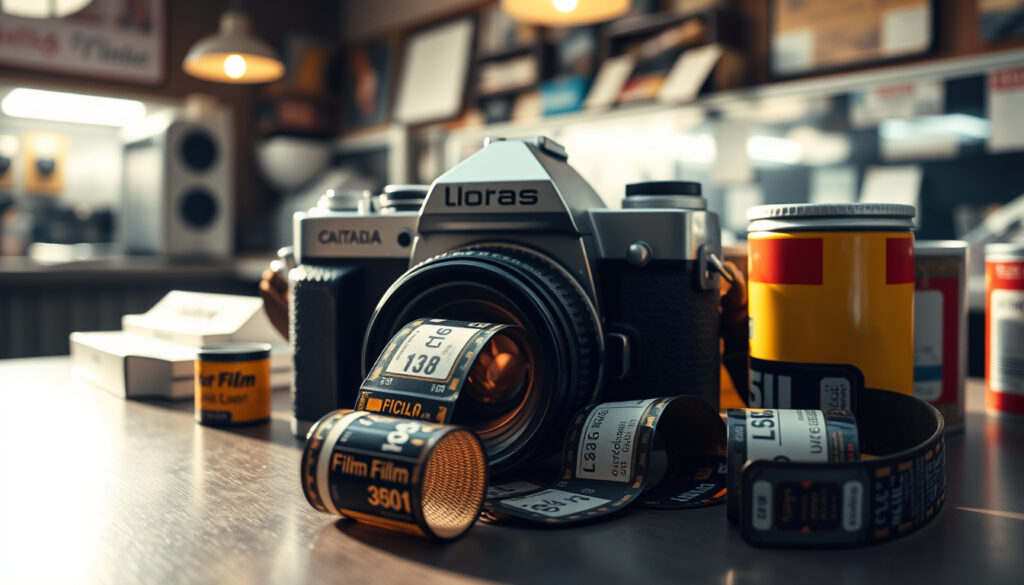
What Is Camera Film? Buying, Prices, and Analog Revival
There’s something about the slow, deliberate act of loading a roll of film that digital can’t quite replicate. For a growing number of photographers — especially Gen Z — camera film isn’t a relic; it’s a deliberate choice.
Year 35mm film introduced: 1934 · Standard exposures per roll: 24 or 36 · Common film speeds (ISO): 100, 200, 400, 800 · Number of film types in common use: 4 (color negative, color slide, black and white, instant)
Quick snapshot
- Film is still produced by Kodak, Fujifilm, Ilford, and others (Kodak (film manufacturer))
- 35mm film is widely available from specialty stores and online (Printpoint Ireland (specialist retailer))
- Expired film can often be developed with adjusted processing (The Darkroom (film lab))
- Whether film production will continue for another decade (Emulsive (film community))
- The exact price trajectory of film (35mmc (analog photography blog))
- How long the current film revival trend will persist (Lomography (film culture platform))
- 1934: 35mm film introduced (Wikipedia (encyclopedia))
- 2023–2024: Gen Z drives film revival on social media (Lomography (film culture platform))
- Demand likely to remain high among hobbyists (Film Photograph (magazine))
- Prices may stabilise if production scales up (B&H Photo (retailer and editorial))
Six key facts at a glance, from the format’s birth to what you’ll actually pay today.
| Attribute | Value |
|---|---|
| Introduced | 1934 (35mm) |
| Standard roll | 24 or 36 exposures |
| Film speed range | ISO 25–3200 |
| Average development time | 10–15 minutes (B&W) |
| Cost per roll | $8–15 (color) |
| Shelf life | 2–5 years (unexpired) |
What is a camera film?
How does film capture images?
- Film is a light-sensitive emulsion on a flexible plastic base (Wikipedia (community-edited encyclopedia))
- When exposed to light, silver halide crystals undergo a chemical change that records the image (Kodak (film manufacturer))
- The more light, the greater the density of the developed negative (Ilford Photo (film manufacturer))
What are the main parts of a film?
- Emulsion: Light-sensitive layer containing silver halide crystals.
- Base: Flexible plastic (usually cellulose triacetate) that holds the emulsion.
- Anti-halation layer: Prevents light bounce-back that would fog the image (Wikipedia (film stock structure))
What types of film exist?
- Color negative: Most common; produces a negative that is then printed or scanned.
- Color slide (reversal): Creates a positive transparency directly.
- Black and white: Can be processed at home easily; offers high contrast.
- Instant: Self-developing film (e.g., Polaroid, Instax) (Fujifilm (instant film manufacturer))
The implication: Understanding the three common film types helps you pick the right stock for your subject — and your budget.
Can I still buy camera film?
Where can I buy film?
- Specialist camera stores like Printpoint Ireland (specialist retailer) stock Kodak Color Plus 200 at €12, Kodak Gold 200 at €13, and Fujifilm 200 at €13.
- Online aggregators like GetLocal.ie (Irish price comparison site) list instant film (Instax Mini at €12.95) and color negative 3-packs (Kodak Gold 3-pack at €49.95).
- Boots Ireland stocks instant film for Instax cameras (Boots Ireland (pharmacy and retail chain)).
Are there online retailers?
- Dedicated film labs: The Darkroom (film processing lab) sells and processes film.
- Major photography retailers: B&H Photo and Adorama ship internationally (B&H Photo (retailer)).
- Manufacturer direct: Ilford and Fujifilm sell through their own stores (Ilford Photo (manufacturer)).
Irish buyers face a narrow but healthy market: Printpoint covers standard color stocks, GetLocal exposes competitive pricing across multiple sellers, and Boots provides instant film for casual shooters. Pro users should order from international specialists if they need niche emulsions.
What this means: You can still buy film without leaving Ireland — but your options are concentrated among a few dedicated retailers. Online aggregators help compare prices across shops.
Why is 35mm film so expensive now?
What factors drive up film prices?
- Low production volumes: Few factories remain, so per-unit costs are high (Emulsive (film industry analysis)).
- Raw material costs: Silver, gelatin, and chemicals have risen (Kodak (manufacturer news)).
- Printpoint Ireland prices show a basic color roll now costs €12–15, while premium stocks like Kodak Portra 400 reach €23 (Printpoint Ireland (retailer)).
Has demand increased?
- New hobbyists, especially young photographers, have driven up demand faster than supply can adjust (BBC News (global news outlet)).
- Social media trends like #filmtok have introduced film to a new generation (Lomography (film culture platform)).
How does inflation affect film cost?
- General inflation raises transport, packaging, and retail overheads (Adorama (retailer and educator)).
- Irish Analog Adventures suggests a reasonable upper bound of €8–12 per roll for standard color negative (Irish Analog Adventures (local film blog)).
Irish buyers paying €12–€23 per roll are already above the €8–12 threshold many hobbyists consider acceptable. The price gap between standard and premium films is narrowing, making film a more expensive habit than it was five years ago.
The pattern: Each price jump reflects a market where fewer factories serve a growing, niche audience. Unless new production lines open, prices will likely stay high.
Why is Gen Z using old cameras?
What appeals to Gen Z about film?
- The tangible, slow process offers a break from the instant gratification of digital (The Guardian (UK newspaper)).
- Each frame costs money, so shooting becomes more deliberate and careful (Wikipedia (film photography resurgence)).
How does film offer a different experience?
- No instant review: You cannot delete or retake immediately, which teaches exposure and composition.
- Anticipation of waiting for development adds emotional value to the final image (Lomography (film culture platform)).
Is it just nostalgia?
- For many, it’s not nostalgia — they never shot film before, so it’s a new aesthetic choice (BBC News (global news outlet)).
- Social media trends, especially #filmtok, have positioned film as a distinctive look (The Guardian (UK newspaper)).
Why this matters: For Gen Z, film isn’t nostalgia — it’s a deliberate rejection of digital perfection. This demographic is the main driver of the revival, and their buying power shapes the market.
Can old film still be developed?
What types of old film can be developed?
- Most black and white and color negative film (C-41 process) can be developed with adjusted times (The Darkroom (film lab)).
- Slide film (E-6) requires more precise chemistry, but many labs still handle it (Happy Ireland Productions (Irish film lab) offers E-6 development).
What are the risks of developing expired film?
- Color shifts (often a warm or magenta cast) are common.
- Increased grain and loss of effective speed (ISO) may require overexposure (Ilford Photo (manufacturer advice)).
- Results are unpredictable but can be artistically interesting (Emulsive (film community guide)).
How to store film to maximise longevity?
- Keep film in a cool, dry place; refrigerator (4°C) or freezer (−18°C) extends life well beyond expiration date.
- Let film warm to room temperature before opening to avoid condensation (Kodak (storage guidelines)).
The trade-off: Expired film offers unpredictable, often beautiful results — but you trade consistency for character. If you’re a beginner, start with fresh stock before experimenting.
Clarity
Confirmed facts
- Film is still produced by Kodak, Fujifilm, Ilford, and others (Kodak (manufacturer)).
- 35mm film is widely available from specialty stores and online (Printpoint Ireland (retailer)).
- Development costs in Ireland: €7 develop-only per roll at Happy Ireland Productions (Happy Ireland Productions (Irish lab)).
- Instant film (Instax) is widely stocked at Boots and online (Boots Ireland (pharmacy)).
What’s unclear
- Whether film production will continue for another decade (Emulsive (industry analysis) notes uncertainty about manufacturing longevity).
- The exact future price trajectory; some analysts expect further increases while others predict stabilisation (35mmc (analog blog)).
- Whether new film manufacturing facilities will come online (Film Photograph (magazine)).
- How long current film stock availability will remain stable (Irish Analog Adventures (local film blog)).
Perspectives from the field
“Photographic film is a strip or sheet of transparent plastic film base coated on one side with a gelatin emulsion containing microscopically small light-sensitive silver halide crystals.”
Wikipedia (community-edited encyclopedia)
“There is a common-sense upper bound of about €8, €10, or €12 for a roll of film, depending on the film type.”
Irish Analog Adventures (local film blog) For those interested in the analog revival, learn more about how streaming services have changed how we watch movies at hur streamingtjänster förändrat hur vi tittar på film.
For Irish buyers, the choice is clear: embrace film now while stocks are available and prices haven’t risen further, or wait and pay more later. The analog revival is real, and it has a price tag.
Related reading: Film Treatment Example: Definition, Length, and Guide
kheffache.com, youtube.com, kevinkheffache.com, youtube.com, followyourarrowfilms.com, thephoblographer.com, bokehphotography.ie, dataintelo.com
For those interested in a classic film SLR, our Canon AE-1 review covers pricing and shooting experience with this iconic model.
Frequently asked questions
Does film require special development?
Yes — different film types need specific chemical processes: C-41 for color negative, E-6 for slide, and black-and-white developer. Labs like Happy Ireland Productions handle all three (Happy Ireland (lab)).
How long does it take to develop film?
Black-and-white takes about 10–15 minutes in a home development kit. Color development at a lab typically takes 1–2 hours for drop-off or a few days by mail (The Darkroom (lab)).
Is digital better than film?
Neither is inherently better; digital offers convenience and instant review, while film provides a distinctive look, deliberate shooting, and a tactile experience (Lomography (comparison)).
Can I use expired film?
Yes — but expect color shifts, increased grain, and reduced effective speed. Overexpose by one to two stops for better results (Emulsive (guide)).
What is the best film for beginners?
Start with a color negative film like Kodak Gold 200 or Fujifilm 200 — they are forgiving, widely available, and priced around €12–13 per roll (Printpoint Ireland (pricing)).
How to load film into a camera?
For 35mm, pull the leader across the take-up spool, close the camera back, advance until the counter shows frame 1, and shoot. Always load in subdued light (Wikipedia (loading instructions)).
Why does film have grain?
Grain comes from the clumping of silver halide crystals in the emulsion. Higher ISO films have larger crystals, producing more visible grain (Kodak (technical explanation)).
How to scan film?
Use a dedicated film scanner (e.g., Plustek, Epson V600) or a flatbed with a transparency unit. Many labs also offer scanning as part of development services (Adorama (scanning guide)).
More related posts
 Utah Utes vs BYU Cougars Match Player Stats (Oct 18, 2025)
 Elaine Hendrix Biography: Age, Movies, and Personal Life
 Cast Of The Life Of Chuck
 Cast Of Goodrich Film
 Alexandra Breckenridge Career: Filmography and Key Facts
 Dylan O’Brien: Accident, Career, Partner, and Personal Life
 Los Angeles Dodgers: History, Rivalries, and Key Facts
 Cast Of Mountainhead
