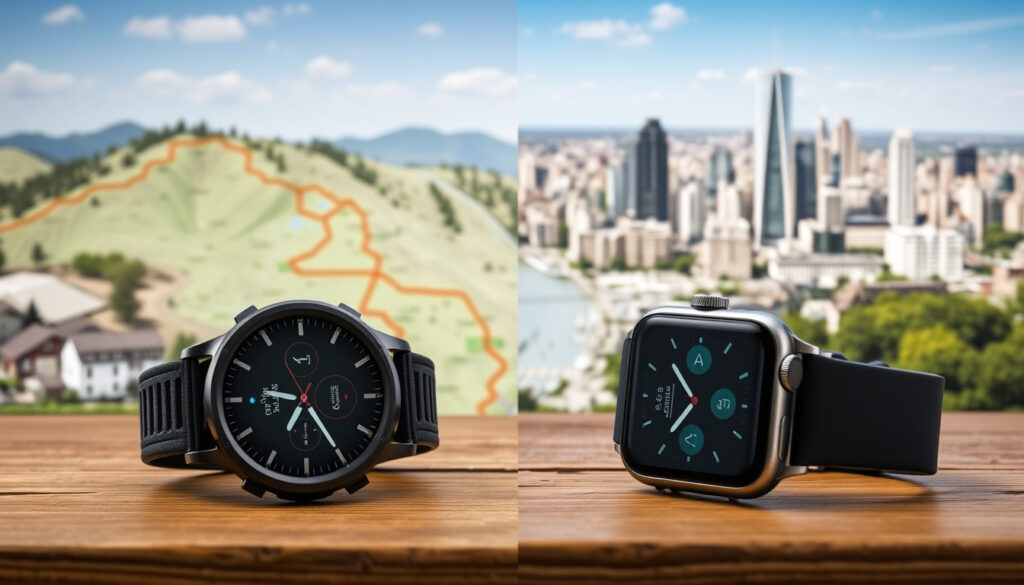
Garmin vs Apple Watch: Which is Better for Your Lifestyle
If you’ve ever stood in an electronics aisle weighing a sports-focused watch against a daily smart companion, you already know the Garmin vs Apple Watch puzzle. The core tension is simple but consequential: one prioritizes battery endurance and outdoor sensor fidelity, while the other wraps health monitoring in a seamless ecosystem.
Battery life (Garmin typical): up to 14 days per charge ·
Battery life (Apple Watch typical): 18–36 hours per charge ·
GPS accuracy advantage: Garmin uses multi-band GNSS, rated higher in third-party tests ·
Monthly fee (Garmin): None ·
Monthly fee (Apple Watch with cellular): Carrier-dependent, typically $10–15
Quick snapshot
- Garmin battery life is 5–14 days vs Apple’s 1–2 days (Garmin Blog (Official))
- Garmin offers offline mapping on non-cellular models (Runner’s World UK (Editorial))
- Apple Watch can take ECG and detect falls automatically (Apple Support (Official))
- No mandatory monthly fee for either device in basic mode (Garage Gym Reviews (Fitness Editorial))
- Which watch is more accurate for heart rate during high-intensity training (varies by model and firmware) (Tim Anderson’s IT Writing (Tech Commentary))
- Whether future Garmin models will add cellular calling with iPhone (Runner’s World UK (Editorial))
- Garmin Fenix 8, Forerunner 965, and Venu 3 dominate 2025-2026 lineup (Garmin Blog (Official))
- Apple Watch Series 11, Ultra 3 continue to push health alerts (Apple Support (Official))
- Garmin likely to expand solar capabilities and training load analytics (Runner’s World UK (Editorial))
- Apple expected to improve battery life in non-Ultra Series (Garage Gym Reviews (Fitness Editorial))
Six key specs tell the story of two very different philosophies.
| Specification | Garmin Fenix 7 | Apple Watch Ultra 2 |
|---|---|---|
| Average battery life (smartwatch mode) | 18 days (Garmin Blog (Official)) | 36 hours (Garage Gym Reviews (Fitness Editorial)) |
| Water rating | 10 ATM (100 meters) | 10 ATM (100 meters) |
| Price range | $199 to $1,199 | $249 to $799 |
| GPS system | Multi-band GNSS (GPS, GLONASS, Galileo) (Runner’s World UK (Editorial)) | Dual-frequency GPS (Garage Gym Reviews (Fitness Editorial)) |
| Offline mapping | Built-in topo maps (Runner’s World UK (Editorial)) | Requires phone |
| Smartphone reply | Pre-set replies only with iPhone (Runner’s World UK (Editorial)) | Full text, calls, dictation |
What can Garmin do that Apple Watch can’t?
Multi-day battery life
- Garmin watches last 5–14 days per charge vs 1–2 days for Apple Watch (Garmin Blog (Official); Runner’s World UK (Editorial))
- Garmin supports solar charging on models like Instinct Solar and Fenix 7 Solar (Garmin Blog (Official))
Built-in sports profiles (trail running, triathlon, golf, etc.)
- Garmin offers 100+ sport modes with data fields that Apple Watch lacks (Runner’s World UK (Editorial))
- Apple Watch has ~20 native modes, more via third-party apps
On-device mapping without a phone
- Garmin provides offline topo maps and compass without a cellular plan (Runner’s World UK (Editorial))
Advanced training metrics (VO2 max, recovery time, training load)
- Garmin tracks training load, recovery, and race predictor (Runner’s World UK (Editorial))
- Apple Watch provides VO2 max estimates but lacks recovery tools
An endurance athlete who hikes for three days straight will face a dead Apple Watch on day two, while a Garmin Fenix 7 still has 16 days of juice. The trade-off: Garmin’s deep sports analytics come at the cost of a less polished smartwatch experience.
Why buy a Garmin instead of an Apple Watch?
Battery life longevity
- Garmin is preferable for endurance athletes and multi-day trips (Runner’s World UK (Editorial))
- Apple Watch excels in app ecosystem, smart features, and phone integration (Apple Support (Official))
Physical buttons for wet/sweaty conditions
- Physical buttons on Garmin work better when gloves or water are involved (Runner’s World UK (Editorial))
The catch: choose your compromise — battery life or phone integration.
If you’re an iPhone user who wants to reply to texts or make calls from your wrist, Garmin’s pre-set reply system feels like a step back. Apple Watch owners get full messaging and dictation without reaching for their phone.
Is Garmin good with iPhone?
App compatibility and notifications
- Garmin Connect works with iOS but cannot reply to texts natively (Runner’s World UK (Editorial))
- You can receive notifications and dismiss calls, but cannot initiate calls
Health data export to Apple Health
- Garmin syncs steps, sleep, and heart rate to Apple Health (Garmin Support (Official))
iPhone users who prioritize battery and fitness over phone features will find Garmin a capable companion. Those who live in iMessage and expect wrist-based replies should stick with Apple.
Is a Garmin watch more accurate than an Apple Watch?
GPS accuracy
- Garmin uses multi-band GNSS (GPS, GLONASS, Galileo) for precise tracking (Runner’s World UK (Editorial))
- Apple Watch Series 9/Ultra 2 uses dual-frequency GPS, comparable in open areas (Garage Gym Reviews (Fitness Editorial))
Heart rate monitoring
- Both devices show small heart rate variations during high-intensity intervals (Runner’s World UK (Editorial))
- Third-party tests show Garmin slightly more consistent for outdoor running (Garage Gym Reviews (Fitness Editorial))
What this means: for dense tree cover, Garmin’s multi-band GNSS gives it an edge, but Apple’s dual-frequency GPS is reliable on open roads.
Can Garmin tell if I’m sick?
Body Battery and stress tracking
- Garmin models with 24/7 heart rate and stress tracking can flag abnormal resting heart rate (Runner’s World UK (Editorial))
- Body Battery shows low energy levels that may correlate with illness (Garmin Support (Official))
Temperature and respiration monitoring
- Some models (e.g., Venu 2, Fenix 7) track respiration rate and skin temperature (Runner’s World UK (Editorial))
- No Garmin watch can diagnose illness; it only provides data trends
“After using both, the Apple Watch is great for medical conditions; Garmin is better for battery and training data.”
— Reddit user, GarminWatches community
“Garmin is the better choice — better battery, better fitness tracking, fewer distractions.”
— Pete Matheson, personal tech reviewer
“Our expert breaks down key differences including design, features, and battery life.”
— Runner’s World tech editor
Does Garmin charge a monthly fee?
More related posts