How to Clean a Flat Screen TV Safely: Step-by-Step Guide
If you’ve ever reached for a paper towel and a bottle of Windex to clean your flat screen TV, you’re not alone — and you’re also risking permanent damage. Samsung, Sony, and LG all explicitly warn against alcohol, ammonia, and abrasive materials (Samsung Support; Sony Support; LG Support). Below are manufacturer-safe instructions and independent testing so you can clean your screen without streaks or regret.
Recommended cloth type: Microfiber (soft, lint-free) ·
Pre-cleaning step: Turn off TV and unplug it ·
Common DIY solution ratio: 50% distilled water + 50% white vinegar
Quick snapshot
- Microfiber cloth is safe for all flat screens (Panasonic Support)
- Alcohol damages anti-glare coatings (Panasonic Support)
- Damp cloth is acceptable if wrung out thoroughly (Panasonic Support)
- Effectiveness of vinegar vs. commercial cleaners on different coatings – no direct brand endorsement
- Optimal cleaning frequency – no consensus among manufacturers
- DIY vinegar solutions – safety on OLED vs LCD screens is not explicitly confirmed by manufacturers
- TV panels are fragile; excessive pressure can cause permanent damage
- Use dry microfiber cloth as the default; only dampen for stubborn marks
- Always let screen dry completely before turning TV back on
Six key facts, one clear pattern: every major TV maker agrees on the basics – dry cloth, no harsh chemicals, gentle touch.
| Label | Value |
|---|---|
| Best tool | Microfiber cloth |
| Avoid | Paper towels, alcohol, ammonia, glass cleaner |
| DIY cleaner mix | 50% distilled water + 50% white vinegar |
| First step | Turn off TV and unplug it |
| Samsung advice | Use a dry cloth first; for stubborn marks, slightly dampen cloth |
| LG warning | No alcohol, thinners, or benzene |
| Sony advice | Unplug before cleaning; use only water on cloth |
| Panasonic caution | Avoid volatile substances, do not spray directly |
What is the safest thing to clean a flat screen TV with?
Soft dry microfiber cloth
- Samsung explicitly recommends a microfibre cloth – soft, clean, lint-free, and dry (Samsung Support (official cleaning guide)).
- LG advises using a dry, soft cloth or a special microfiber cloth (LG Support (US Help Library)).
- Sony says to clean the screen with a soft dry cloth (Sony Support (FAQ)).
Distilled water (for light dust)
- If dust is the only issue, distilled water applied sparingly to the cloth works – no chemicals needed (Samsung Support).
- Tap water may leave mineral streaks; distilled water avoids that problem (YouTube – consumer tip).
Pre-mixed screen cleaning wipes (if alcohol-free)
- Some commercial screen wipes are labeled safe for electronics, but check that they contain no alcohol or ammonia. No major TV brand officially endorses a specific wipe.
The safest tool is a dry microfiber cloth. Anything else increases risk. Manufacturers explicitly say: never spray liquid directly on the screen (Samsung Support; LG Support).
The implication: start with the simplest, driest method. Most dust and light smudges come off with a dry microfiber cloth alone. Only escalate to moisture when the mark refuses to budge.
What’s the best homemade TV screen cleaner?
50% distilled water + 50% white vinegar recipe
- Some consumer guidance suggests mixing equal parts distilled water and white vinegar for stubborn smudges (Loop TV (consumer blog)).
- This mixture is less universally endorsed by manufacturers than plain water. Samsung and Sony do not mention vinegar in their official guidance.
Alternative: very mild dish soap in distilled water
- Consumer Reports suggests that highly diluted dish soap in water is safe for stubborn stains (Consumer Reports (independent testing)).
- Use one drop of mild dish soap per cup of distilled water. Apply to cloth, not directly to screen.
Storing and applying homemade cleaner
- Mix fresh each time. Do not store in a spray bottle – the temptation to spray directly is too high and manufacturers forbid it (Samsung Support).
Can I use a damp cloth to clean my flat screen TV?
How to dampen the cloth correctly
- Samsung says: use a dry cloth; if needed, slightly dampen with water (Samsung Support).
- Sony says: for stubborn dirt use a slightly damp cloth (Sony Support).
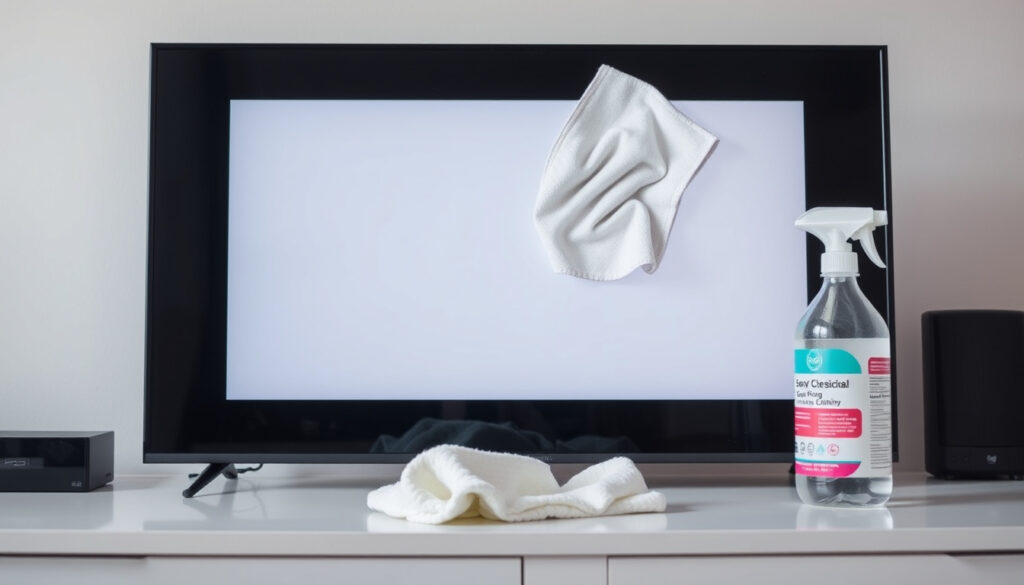
- Key technique: spray water onto the cloth, not the screen. Wring thoroughly so it is damp, not wet.
Risk of moisture damage and streaks
- A wet cloth can cause liquid to drip into edges and damage internal components (Panasonic Support (safety note)).
- Mineral deposits from tap water create streaks; use distilled water to avoid this.
Alternative: lightly dampened microfiber for smudges
- Two-cloth method: one slightly damp microfiber for cleaning, one dry microfiber for buffing (YouTube – consumer demonstration).
The catch: moisture is allowed but only under strict control. If you need a damp cloth, wring it until barely moist, clean gently, then immediately dry with a second cloth.
What not to clean a TV screen with?
Avoid paper towels and rough fabrics
- Consumer Reports warns against paper towels, alcohol, and ammonia (Consumer Reports (guide)).
- Samsung advises against abrasive pads and paper towels (Samsung Support).
Avoid alcohol, ammonia, and window cleaners
- Samsung says never to use window cleaner, benzene, ammonia, or alcohols (Samsung Support).
- LG says not to use alcohol, thinners, or benzene (LG Support).
- Panasonic advises against benzine, thinner, and alcohol (Panasonic Support).
Avoid abrasive cleaners and sponges
- Any product with scouring powder, soaps, or abrasive pads will scratch the screen (Samsung Support).
The forbidden list is long but consistent: no ammonia, no alcohol, no abrasives. If it’s not a microfiber cloth and distilled water, it’s likely not safe.
Why this matters: anti-glare coatings are delicate. A single wipe with Windex can dissolve those coatings, leaving permanent blotches. The warning across Samsung, Sony, LG, and Panasonic is unanimous.
How Should I Clean my Samsung TV Screen?
Samsung official steps (dry cloth first)
- Unplug the TV (Samsung Australia Support).
- Use a soft, clean, lint-free dry microfiber cloth for the frame and screen.
- Wipe gently; if marks remain, slightly dampen the cloth with water and use circular motions (Samsung Support).
- Let the screen dry completely before plugging back in.
Dealing with fingerprints on Samsung screens
- For fingerprint smudges, the slightly damp cloth method with gentle circular motions is recommended. Do not press hard – the panel is fragile (Samsung Support).
Where to find Samsung cleaning instructions
- Full details are available on Samsung’s support page for your region. Samsung UK also advises never to spray liquid directly on the TV (Samsung UK Support).
The trade-off: Samsung’s guidance allows water only as a last resort. Most users will never need anything beyond a dry cloth.
Step-by-Step: How to Clean Your Flat Screen TV Safely
- Turn off and unplug the TV. Let it cool for a few minutes. (Samsung Support)
- Dust with a dry microfiber cloth. Wipe top to bottom using light pressure.
- If smudges remain, dampen the cloth slightly. Use distilled water. Wring until barely moist.
- Clean stubborn marks with gentle circular motions. Never press hard. (Samsung Support)
- Dry immediately with a second microfiber cloth. This prevents streaks.
- Let the screen air-dry completely before plugging back in. (Samsung Support)
This routine keeps your screen in pristine condition without voiding any warranties.
Confirmed facts
- Microfiber cloth is safe for all flat screens
- Alcohol damages anti-glare coatings
- Damp cloth is acceptable if wrung out thoroughly
What’s unclear
- Effectiveness of vinegar vs. commercial cleaners on different coatings
- Optimal frequency of cleaning – no consensus among manufacturers
- DIY vinegar solutions – safety on OLED vs LCD screens is not explicitly confirmed by manufacturers
What the experts say
“Use a soft, clean, lint-free, dry cloth. If needed, slightly dampen the cloth with water and use circular motions. Never spray water directly onto the screen.”
Samsung Support (official cleaning guide)
“Clean the screen with a soft dry cloth. For stubborn dirt, use a cloth slightly moistened with water. Do not use solvents, detergents, or abrasives.”
Sony Support (OLED and LCD TV advice)
“If you need something more than a dry microfiber cloth, a drop of dish soap in distilled water is safe for tough smudges. But never use paper towels, alcohol, or ammonia.”
Consumer Reports (independent testing)
The consensus among experts leaves no room for shortcuts: gentle, dry cleaning is the gold standard.
The verdict from every major TV manufacturer and Consumer Reports is the same: dry microfiber cloth first, water only when needed, and never harsh chemicals. For anyone with a modern flat-screen TV, the choice is clear: stick to a dry microfiber cloth and never spray liquids directly on the panel. Your screen’s anti-glare coating depends on it.
Related reading: **Sanus TV Mount Guide** · **Roku Customer Service**
Frequently asked questions
How often should I clean my flat screen TV?
There is no official recommendation from manufacturers. Clean only when you see dust or smudges. Over-cleaning risks damage.
Can I use Windex on a flat screen TV?
No. Windex contains ammonia and alcohol, which can strip the anti-glare coating. Samsung, Sony, LG, and Panasonic all prohibit these chemicals.
Is it safe to use a microfiber cloth with just water?
Yes, and it is the preferred method for stubborn spots. Use distilled water and wring the cloth thoroughly before wiping.
Should I use circular motions when cleaning the screen?
Samsung recommends gentle circular motions for stubborn marks. For general dust, wipe in straight lines from top to bottom.
What is the best cloth for removing fingerprints?
A microfiber cloth slightly dampened with distilled water works well. Buff dry with a second microfiber cloth. (Samsung Support)
Can I clean a TV while it is on?
No. Always turn off and unplug the TV before cleaning. This prevents electric shock and allows you to see dust and smudges more clearly. (Samsung Support)
Does cleaning remove the anti-glare coating?
If you use harsh chemicals or abrasive materials, yes. Stick to a dry microfiber cloth and distilled water to preserve the coating.
More related posts