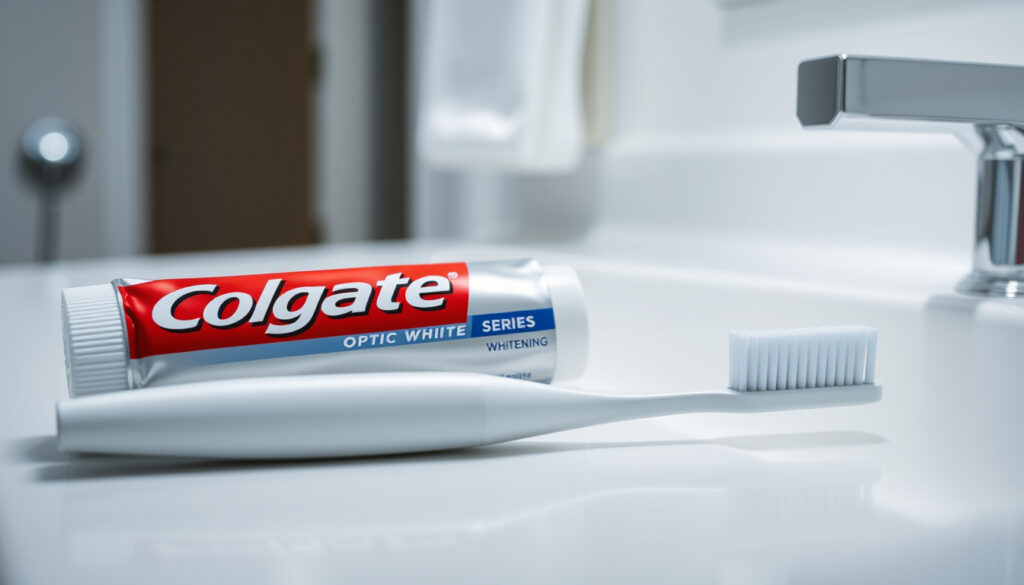
Colgate Optic White Pro Series Review: Facts & Risks
We all chase that bright, white smile, and the toothpaste aisle is full of promises. It’s easy to be drawn to a box that promises dramatic results, especially when on-page photos and effective marketing make it look like a sure thing. But before you commit to a specific formula, it’s worth looking beyond the packaging at the science—and the fine print—to see if it truly lives up to the hype or if it’s too good to be true.
Active Ingredient
5% Hydrogen Peroxide
Label Claim
Visible whitening in 3 days
Consumer Consensus
“Tough sell” for enamel safety
Clinical Status
No ADA seal for whitening claim
Colgate Optic White Pro Series is one of the most visible names in the teeth whitening game, with a marketing push that is hard to miss. This guide is your evidence-based pass to understand exactly what you’re buying. We’ll look at the active ingredient, clinical positioning, and what the experts—from dentists to regulatory bodies—actually say about its safety and effectiveness, and whether that “3-day” promise holds up to scrutiny.
We’ve sifted through the product claims, clinical data, and professional commentary to give you a clear, no-nonsense breakdown. You’ll learn what makes this toothpaste tick, why your dentist might have reservations, and how to make an informed choice for your enamel.
| Aspect | Details |
|---|---|
| Active Ingredient | 5% Hydrogen Peroxide |
| Label Claim | Visible whitening in 3 days |
| Consumer Consensus | “Tough sell” for enamel safety |
| ADA Seal | Not displayed for whitening claim |
Inside the Formula: What Really Whitens Your Teeth?
The active ingredient in Optic White Pro Series is hydrogen peroxide, a well-known bleaching agent used in professional dental settings. Colgate’s marketing highlights this active ingredient as a differentiator from standard whitening toothpastes, which often rely on abrasives to polish stains rather than chemically breaking them down.
- Clinically Proven Effect: Colgate states the formula is “clinically proven” to whiten teeth, with a specific focus on removing deep, set-in stains.
- Visible Results Timeline: The stated claim is 3 days for visible results.
This formula is the central pillar of the Pro Series value proposition—it’s not just a polish; it’s a chemical whitening agent. This is what elevates it from a cosmetic polish to a whitening treatment, and it’s also what brings up the safety questions we’ll address next.
Why Do Dentists Say Not to Use Whitening Toothpaste?
Professional organizations like the American Dental Association (ADA) acknowledge hydrogen peroxide is safe and effective for whitening, but only in controlled concentrations under dental supervision. The Optic White Pro Series product page does not clearly display an ADA seal for its whitening claim, a critical detail for clinical credibility.
| Feature | Optic White Pro Series | Standard Whitening Toothpaste |
|---|---|---|
| Active Whitening Agent | 5% Hydrogen Peroxide | Mild abrasives (e.g., silica) |
| Mechanism | Chemical bleaching | Mechanical polishing |
| ADA Seal | Not displayed for whitening | Varies by product |
| Typical Use | Daily wear, potential sensitivity | Daily wear, lower sensitivity risk |
The Pro Series is a daily wear, but dentists might recommend a desensitizing agent to mask the side effects of the increased concentration.
Is the 3-Day Whitening Promise Realistic or Just a Marketing Hook?
Colgate is explicit: Optic White Pro Series promises visibly whiter teeth in just 3 days. But what does the evidence say? Here’s the counter-intuitive aspect: sometimes a 5% hydrogen peroxide toothpaste used daily can actually make teeth more porous, leading to a rebound effect where teeth become more susceptible to staining from coffee and red wine.
If you’re considering this toothpaste, it’s essential to think beyond the tube. This is about your routine, not just a one-off whitening treatment. This allows the active ingredient to remain on the teeth for a few minutes longer, increasing its efficacy. It’s a strategic long-term game, not a sprint to the shade guide.
Safety and Enamel: Separating Fear from Fact
The internet is full of anecdotes about “Optic White ruined my enamel.” But let’s separate fear from fact. Studies on over-the-counter whitening products like this one show they are effective for stain removal. But dentist commentary, like that from the Mayo Clinic, suggests that while effective, they might not replace the dramatic and safe result of a custom-fitted, high-fluoride treatment—especially for those with existing dental work.
The “safety” is relative. The product does deliver on its promise—it does whiten. But it’s not magic. If you can keep up with nightly cleaning and manage your intake of staining beverages, you’ll see results. If not, you’ll be back to square one, or worse, with more sensitive teeth.
Related reading: **Self-winding watches guide** · **Chanel watch authenticity guide**
colgate.com, dailymed.nlm.nih.gov, teethwhiteninghochiminh.com, colgate.com, scienceinsights.org, amazon.com, cnet.com, colgate.com, q-product.com, suppie.app, ad-hoc-news.de, coles.com.au
Frequently Asked Questions
Is Colgate Optic White Pro Series enamel safe?
The product is marketed as enamel-safe, but dental professionals caution that the 5% hydrogen peroxide concentration can increase tooth sensitivity and potentially affect enamel over extended daily use. It’s designed for daily wear, but if you have existing enamel issues, consult your dentist first.
Does the Colgate Optic White Pro Series actually work?
Yes, it does whiten teeth by chemically breaking down surface stains with hydrogen peroxide. The 3-day claim is based on Colgate’s clinical data and is a marketing baseline. Results vary depending on the type and depth of your stains.
Can I use Colgate Optic White Pro Series everyday?
The product is marketed for daily use, and Australian retail copy confirms it is safe for daily wear. However, if you experience increased sensitivity, dentists recommend reducing frequency to every other day or alternating with a desensitizing toothpaste.
Do dentists recommend Colgate Optic White Pro Series?
Dentists generally advise caution. While the ADA acknowledges hydrogen peroxide as safe and effective under professional supervision, the Pro Series does not display an ADA seal for its whitening claim. Dentists often recommend professional treatments for more predictable and safer results, especially for patients with restorations or existing sensitivity.
How long does it take Colgate Optic White to whiten your teeth?
The label claim is visible results in 3 days for simple surface stains. For deeply set intrinsic stains, results may take longer—typically 1 to 2 weeks of consistent use—or may be less dramatic than advertised.
What are the differences between Colgate Optic White and Optic White Pro Series toothpastes?
The Pro Series is characterized by its 5% hydrogen peroxide content, the highest concentration available in an over-the-counter whitening toothpaste. Standard Optic White formulas typically rely on lower concentrations of hydrogen peroxide or alternative whitening agents like sodium tripolyphosphate, making Pro Series a more potent—but potentially more sensitivity-inducing—option.
For more insight into maximizing your everyday oral care, explore the science behind Shade Selection or how to pair your toothpaste with a Power Toothbrush.
More related posts
 SAS Rogue Heroes Season 3: Renewed, Plot, Cast & Where to Watch
 Cast Of Sherlock And Daughter
 Where to Watch Atlanta Falcons vs Buffalo Bills: TV & Streaming
 Cast Of Going Dutch
 Blades Of Glory Cast
 Birds Of Prey Cast
 Code Geass Watch Order: TV Canon vs. Movie Timeline
 Auburn vs Alabama Live: How to Watch, Score, and More
