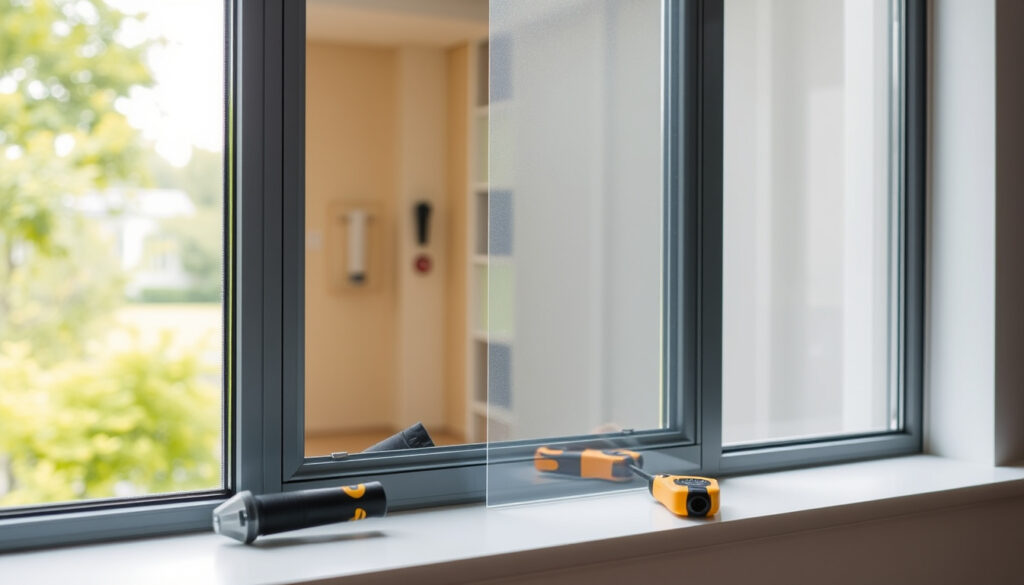
Smart Film for Windows: Cost, Lifespan, DIY & Downsides
Few home upgrades deliver the same “wait, that’s real?” moment as a window that turns from frosted to clear at the flip of a switch. Smart film for windows does that with a thin PDLC layer on your existing glass — and at roughly $25–$80 per square foot installed, it runs far below the cost of replacing windows with built-in smart glass (Modernize, home improvement cost guide).
Technology: Polymer Dispersed Liquid Crystal (PDLC) ·
Switch mechanism: Electric current toggles between frosted and clear ·
Typical lifespan: Roughly 10+ years depending on product ·
Price position: Premium over standard tint, less than replacement smart glass
Quick snapshot
- PDLC film switches between frosted and clear when voltage is applied (Smart View Smart Glass, PDLC supplier guide)
- Self-adhesive retrofit versions apply to glass you already own (Smart View Smart Glass, PDLC supplier guide)
- Installed smart film typically runs $25–$80 per square foot in retrofit projects (Modernize, home improvement cost guide)
- Per-brand lifespan claims vary from 10 to 20 years, but independent long-term field data is thin
- No large-scale data compares DIY installation reliability with professional work
- Extreme temperatures and high humidity are the least documented real-world conditions
- About 10 years is the typical lifespan estimate from independent cost guides (HomeAdvisor, home services cost database)
- Premium PDLC film is rated for 10–15 years, with switching cycles quoted as high as 80 million+ (CoolVu, smart glass technology guide)
- Some manufacturer specs stretch the range to 10–20 years (HomeGuide, cost research site)
- Electrical components can add $200–$800 per zone before labor (Rapid Window Tinting, LA tinting shop pricing guide)
- Budget film from marketplace suppliers runs $25–$50 per square foot including controller and transformer (Alibaba Smart Buy, supplier buying guide)
- A three-window living room installation may total $2,000–$2,500 including controller (Smart Home Explorer, smart home product guide)
Key facts at a glance
One product, one set of facts that actually matter: what the film is, what it needs, and where it belongs.
| Item | Detail |
|---|---|
| Core technology | PDLC film embedded between adhesive layers |
| Power state | Clear or frosted depending on voltage (varies by product) |
| Control options | Wall switch, remote, or app |
| Retrofit | Self-adhesive backing applies to existing glass |
| Common uses | Offices, clinics, home windows, and retail |
| Installation mode | Surface-applied film; no glass replacement needed |
| Key consideration | Requires wiring for power; professional install recommended |
The takeaway: smart film is an electrical product first and a window product second, and the spec sheet matters more than the brand sticker.
How much does switchable smart film cost?
If you search for a clean national price, you won’t find one — the market splits into two tiers, and the final number depends on film grade, window count, and how many control zones you want.
Smart film for windows cost per square foot
- $30–$45 per square foot — HomeAdvisor’s average estimate (HomeAdvisor, home services cost database)
- $25–$50 per square foot — Angi’s estimate range (Angi, home services marketplace)
- $50–$120 per square foot for material alone, plus $15–$40 per square foot labor and $200–$800 per zone for electrical (Rapid Window Tinting, LA tinting shop pricing guide)
- $45–$55 per square foot for premium film in a smart-home build-out, according to Smart Home Explorer, smart home product guide
The per-window total is the number that hurts or surprises. A standard 15-square-foot residential window can land between $1,125 and $2,625 installed (Rapid Window Tinting, LA tinting shop pricing guide), while a 3×5-foot premium panel runs $675–$825 (Smart Home Explorer, smart home product guide).
Why switchable film costs more than standard tint
Standard tint is a passive adhesive layer. Smart film is an electronic assembly with a controller, wiring, and a power supply — the price gap is the price of the switch itself.
That’s why the comparison to tint never looks flattering on paper. You’re paying for two states instead of one, and the electronics that make the second state possible.
Installation and control system costs
- The larger the pane, the more the labor line grows
- Independent control zones multiply the electrical cost
- The controller and transformer are usually bundled with the film, not optional extras
The implication: when you compare quotes, ask for the line-item breakdown. A cheap film price can hide an expensive control layout, and a premium film price can look reasonable once labor is included.
Is smart window tint a real thing?
Yes — and it’s been commercially available for years. The technology has a name you’ll see on every spec sheet: PDLC, or polymer dispersed liquid crystal.
What is PDLC smart film?
- Liquid crystal droplets sit inside a polymer layer, sandwiched between transparent conductive films (CoolVu, smart glass technology guide)
- Applying low-voltage current aligns the crystals and the film turns clear
- Removing power scatters light and the film turns frosted
The same switching physics powers the privacy glass you’ve seen in offices and clinics — the film version just puts that mechanism on a roll you can apply to glass you already own.
Does smart film work at night?
- In the clear state, the film is transparent, so the glass behaves like ordinary clear glass after dark
- In the frosted state, light scatters — interior lamps look diffused and outside viewers can’t see details clearly
Most PDLC film is clear only while powered, which is worth remembering at night: if you leave it in the powered state, it behaves like a normal window; switch it off and it becomes the privacy surface.
Does Smart Tint block sunlight?
- Solar control is not the film’s primary job — it’s a privacy product first
- UV and heat rejection depend on the specific film build-up, so check the manufacturer’s ratings
- One durability catch: UV exposure and temperature swings are documented causes of adhesive peeling (HomeGuide, cost research site)
Buyers who expect tint-like heat rejection are the ones who end up disappointed in reviews. Smart film blocks the view, not the sun — unless the spec sheet says otherwise.
The pattern: the same physics that makes the switch work also explains what the film can’t do. It’s an optical switch, not a solar shield.
What are the downsides of using window film?
The honest list of downsides is shorter than the marketing suggests, but the three that matter are cost, power dependency, and the fragility of the install.
Cost vs. standard window tint
- Standard tint is a passive film with a single appearance; smart film offers two states at several times the price
- The premium is why most residential buyers use smart film on a few key windows, not the whole house
If your goal is glare or heat control, smart film is the wrong tool. If your goal is privacy on demand, it’s the only film that delivers it without curtains or blinds.
Power wiring and outlet requirements
- PDLC systems typically run on low-voltage AC — commonly 48V to 65V — so a transformer sits between the wall circuit and the film (Smart View Smart Glass, PDLC supplier guide)
- Controllers are often tied to a wall switch, remote, or app, which means retrofit wiring has to reach the window
For a rental or a strictly no-drill space, that wiring is the dealbreaker. The film can be cut and stuck to glass, but the electrical connection turns a one-day project into a two-trade project.
Potential installation problems: bubbles, dust, peeling
Moisture is the film’s main enemy. It can wick into the edges of the film and cause the layers to separate over time — which is why edge sealing and dry installation conditions matter (Smart View Smart Glass, PDLC supplier guide).
Dust and bubbles are the other classic failure: once the adhesive layer touches the glass, there’s no pulling it up and redoing it cleanly. UV exposure and temperature swings add the second long-term risk, with the adhesive peeling from the glass over time (HomeGuide, cost research site).
How long does Smart Glass film last?
The honest answer: long enough for most residential buyers, but shorter than the window itself — and shorter than some ads imply.
Average lifespan of smart film
- About 10 years is the typical estimate from Angi (Angi, home services marketplace)
- 50,000+ switching cycles equals roughly 10 years of daily use — the minimum buyers should look for, according to Alibaba Smart Buy, supplier buying guide
- Manufacturer lifespan claims range up to 20 years, but the spread is wide enough that 10 years is the right planning number
Warranty expectations
- Warranty terms vary by brand and installer, and they usually track the rated lifespan of the film
- Ask whether the warranty covers the controller and transformer, not just the film itself
This matters more than the sticker price: an inexpensive film with a clear warranty is worth more than a premium film with a vague one.
Factors that shorten film life
- UV exposure and temperature swings can cause the film to peel from the glass over time
- Moisture at the edges can wick into the layers and cause delamination
- Dust or bubbles from a rushed DIY install create stress points that grow over the years
The planning number that makes sense for most budgets is 10 years. If the film is still clean at year 12, treat it as a bonus — and keep the invoice somewhere safe for warranty claims.
The implication: anyone quoting you a 25-year product life is quoting marketing, not data.
Can I install smart tint myself?
Some manufacturers sell smart film as a DIY product, and the film itself can absolutely be cut to size. But DIY doesn’t mean no-tools — the electrical connection is the part that catches people out.
Can I cut Smart Film?
- Yes — the film can be trimmed with a sharp blade, just like standard window tint
- Most self-adhesive smart film is sold in rolls or cut-to-size panels, so the cutting requirement is modest
The physical install — clean glass, cut film, squeegee out air — is familiar to anyone who has applied window tint. The unfamiliar part is what happens next: connecting the film to a controller and power.
Tools needed for DIY installation
- Cleaning supplies, spray bottle, squeegee, sharp knife, measuring tape
- A controller and transformer matched to the film’s voltage
- Basic electrical tools — or an electrician for the mains connection
Installing the film is a half-day project on an easy-to-reach window. Adding the electrical work is where the half day can turn into an appointment with a licensed electrician.
When to hire a professional
DIY saves the labor line on your quote, but dust, bubbles, and edge moisture are exactly the conditions that shorten film life and complicate warranty claims.
For a single rental window or a quick home-office privacy upgrade, DIY is reasonable. For multiple panes, tall ceilings, or humid rooms like bathrooms and kitchens, a professional install with proper edge sealing is the lower-risk route.
The catch: you can cut the film, but you probably shouldn’t cut the electrical work.
Which Smart Glass film is the best?
There’s no single best smart film, because the product that’s right for a bathroom window is different from the one that belongs in a conference room. What separates good purchases from regretted ones is a short list of selection criteria.
What are people saying about Smart Tint in reviews?
- Feedback clusters around three themes: the wow-factor of the switch, the difficulty of a bubble-free install, and the cost of the control system
- Forum users consistently describe the install as the hard part — not the film’s switching performance
- Negative reviews often trace back to expectations: buyers expecting tint-like heat rejection are disappointed
That pattern matches what installers say: the product delivers on privacy, and the problems start at the edges — literally and figuratively.
What is the best brand of auto window tint film?
- For automotive use, the PDLC film category is thinner and less documented than residential film, so brand claims deserve extra scrutiny
- Apply the same test as residential: switching cycles, warranty, cut-to-fit ability, and seller reputation
If a seller can’t show you a switching-cycle rating or a written warranty, the brand name isn’t the risk — the missing spec sheet is.
Smart Film for windows with remote: key features
- Control options: wall switch, remote, or app — decide before buying, because the controller is usually bundled
- Size: confirm the film can be trimmed to your exact pane dimensions
- Cycle rating: 50,000+ cycles is the number that separates durable film from disposable film
The hidden variable is size. A small privacy panel for a bathroom is a very different purchase than a 6×6-foot partition, and the per-square-foot price only makes sense once you add the controller to the total.
Smart film vs. window tint vs. smart glass
Three retrofit paths, one pattern: the more switching you want, the more electronics you pay for and the higher the installed cost climbs.
| Option | Installed cost per sq ft | Rated lifespan | The trade-off |
|---|---|---|---|
| PDLC smart film (retrofit) | $25–$80 (Modernize, home improvement cost guide) | About 10 years typical | Keeps existing glass; needs wiring and a controller |
| Standard window tint | Lowest — passive film with no controls | Not rated for switching | Fixed appearance; no privacy on demand |
| Smart glass (full pane) | $70–$150+ (CoolVu, smart glass technology guide) | 10–20 years in manufacturer specs | Cleanest integrated look; requires replacing the window |
What the comparison actually shows: film is the retrofit compromise, tint is the budget compromise, and smart glass is the premium compromise. There is no free lunch — only different places to spend the money.
Smart film specifications at a glance
One table, two things worth remembering: the cycle rating tells you how long the switch will last, and the lifespan tells you what the warranty should cover.
| Specification | Typical value |
|---|---|
| Film type | PDLC (polymer dispersed liquid crystal) |
| Switching states | Clear and frosted (opaque) |
| Control options | Wall switch, remote, or app |
| Recommended switching cycles | 50,000+ cycles, about 10 years of daily use (Alibaba Smart Buy, supplier buying guide) |
| Rated lifespan | About 10 years typical, up to 20 years in some specs (HomeAdvisor, home services cost database; Angi, home services marketplace) |
| Installation mode | Self-adhesive retrofit onto existing glass |
| Typical applications | Offices, clinics, home windows, retail |
The catch is in the last two rows: this is a retrofit product, but it behaves like an electrical appliance. Plan the power before you fall in love with the finish.
Pros and cons of smart window film
Pros
- Privacy on demand without replacing windows
- Retrofits onto glass you already own
- Lower installed cost than full smart-glass replacement
- Controllable by wall switch, remote, or app
- Can be trimmed to size like standard film
Cons
- Costs significantly more than standard window tint
- Requires wiring, a controller, and a power source
- Installation is unforgiving: dust, bubbles, and edge moisture cause lasting defects
- Typical lifespan around 10 years — shorter than the glass itself
- Not a substitute for solar-control tint in most builds
The balance is clear: smart film trades money and complexity for a capability that no passive tint can match — switchable privacy.
Smart film installation: step by step
For anyone taking the DIY route, the sequence below is the one installers follow. Preparation is the entire game.
- Measure the glass and order the film slightly larger than the pane; you’ll trim the edges after application.
- Clean the glass thoroughly. Dust and debris are the most common cause of bubbles and weak adhesion.
- Cut the film to size with a sharp blade — smart film trims like standard tint.
- Peel the backing and apply the film with a squeegee, working from the center toward the edges to push out air and water.
- Connect the controller and transformer. PDLC systems operate on low-voltage AC, and the mains connection is the step to hand to an electrician if you’re not comfortable with wiring.
- Seal the edges and test the switching cycle before final trimming.
If the window is easy to reach and you’ve applied film before, budget half a day. If it’s a tall commercial pane or a humid room, the electrical and edge-sealing work justify a professional.
The trade-off: you can cut the film, but you can’t cut the electrical work — budget for it either way.
What’s confirmed and what’s still unclear
Confirmed facts
- PDLC smart film is a real, commercially available product with established cost guides
- The film requires an electric current to switch between frosted and clear
- Self-adhesive retrofit versions are available for existing glass
- Smart film costs more than conventional window tint
What’s unclear
- Exact lifespan for specific brands without long-term field data
- Reliability of DIY installation compared with professional work
- Performance in extreme temperatures and high-humidity environments
- Whether budget marketplace film performs like premium film over a decade
- Real-world switching failure rates, since most published numbers are manufacturer ratings
The asymmetry is worth noting: confirmed facts outnumber open questions, but the open questions are exactly the ones that determine whether a cheap quote is actually cheap.
What people say about smart film
Three voices show up again and again in smart film conversations: the manufacturer’s pitch, the DIY owner’s reality, and the specialist retailer’s practical framing.
One pane, two states: film that switches from transparent to translucent for privacy on demand, without replacing the window.
— Paraphrased from smart film manufacturer materials (smartfilm.com), product position
The film switches in a second, but the install is the real project. Cleaning, cutting, and chasing bubbles takes patience, and the electrical connection is where first-timers reach for help.
— Paraphrased from a contributor on Reddit’s r/WindowTint, firsthand PDLC install account
Self-adhesive smart film is the retrofit play: switchable privacy on glass you already own, at a fraction of the cost of replacing the window.
— Paraphrased from SmartGlassCountry product team, specialist retailer perspective
The through-line: manufacturers sell the switch, owners experience the install, and retailers sell the retrofit framing. All three are right — which is why the buying decision should separate product performance from installation reality.
What this means for your window budget
Smart film for windows is a real product with a real price tag and a simple trade at its center: you pay more than tint and less than smart glass to turn an ordinary pane into a two-state privacy surface. The projects that go wrong are rarely the film’s fault — they’re the result of an under-quoted control system, a rushed install, or wiring that should have been left to a professional. The first question isn’t “which film?” It’s “what exactly is included in that number?” For the DIY homeowner, the choice is clear: spend the labor budget on a professional install once, or risk spending it twice on fixes.
Related reading: CoolVu · Smart View Smart Glass
latestcost.com, smartfilmsinternational.com, rapidwindowtinting.com
Frequently asked questions
Can smart film be applied to double-pane windows?
Yes, in most cases. The film goes on the interior surface of the glass, so the double-pane unit is left alone. The main precaution is moisture: water that wicks into the film edges can cause the layers to separate over time, so dry, well-sealed edges matter more than the window construction.
Does smart film need to be powered all the time?
It depends on the product. Most PDLC film is clear when powered and frosted when unpowered, which means it draws power while you want the clear state. Some products reverse that behavior or only draw power during the switch. Confirm the power state on the spec sheet before buying.
Will smart film block UV rays?
Not automatically. PDLC film is designed for switching rather than solar control, and UV rejection depends on the specific film build-up. If UV blocking is a goal, check the manufacturer’s UV-rejection rating — and remember that UV exposure can also shorten the film’s edge life over time.
Can smart film be removed without damaging windows?
Yes, because it’s an adhesive film, it can be peeled off — but removal is slower and messier than standard tint. Adhesive residue and moisture trapped under the film can complicate the job. Most installers treat smart film as a semi-permanent upgrade: removable in principle, but not something you’ll want to reposition after it cures.
Does smart film work in cold weather?
The switching layer generally works in cold conditions, but the installation suffers: cold glass makes the adhesive harder to seat and increases condensation risk at the edges. If you’re installing in winter, warm the room and the glass first.
Is smart film safe for windows with low-E glass?
In most cases the film is applied to the interior surface, so it doesn’t physically touch the low-E coating. Since window warranties vary by brand, confirm with the window manufacturer before adding any adhesive film.
Related reading
- CoolVu — smart glass film technology and pricing overview
- Smart View Smart Glass — what to know before buying PDLC smart film
More related posts
 Cast Of The Boy And The Heron
 Paris Jackson: Biography, Paternity, Net Worth & Identity
 Ghost Rider (2007): Hit or Flop? Box Office Breakdown
 1992 (film) – Is it Based on a True Story? Cast, Netflix & More
 Soundbar Mount: Installation, Compatibility & Best Picks
 Cast Of The Woman In The Yard
 Cast Of Spidey And His Amazing Friends
 Many Saints Of Newark Cast
